The Three Jobs Your HVAC System Does
Most homeowners think of HVAC as a furnace in winter and an air conditioner in summer. In reality, it's one interconnected system doing three distinct jobs simultaneously: heating, ventilating, and air conditioning.
Heating warms indoor air using a furnace or heat pump. Ventilation exchanges stale indoor air with fresh outdoor air and manages humidity. Air conditioning removes heat and moisture from indoor air, making rooms feel cooler. All three functions typically share the same ductwork, air handler, and filter - which is why a problem in one area often affects the whole system.
Understanding these three roles together helps explain why your home's core systems are deeply interconnected, and why HVAC decisions rarely exist in isolation.
~50%
Share of home energy use from HVAC
The U.S. Department of Energy estimates that heating and cooling account for roughly half of a typical home's total energy consumption.
15-25%
Conditioned air lost through duct leaks
According to the U.S. Department of Energy, leaky duct systems in typical homes can lose 20-30% of conditioned air, reducing system efficiency significantly.
15-20 years
Typical lifespan of a central AC unit
Industry guidance from HVAC trade organizations suggests central air conditioners generally last 15 to 20 years with regular maintenance.
How Air Moves Through the System
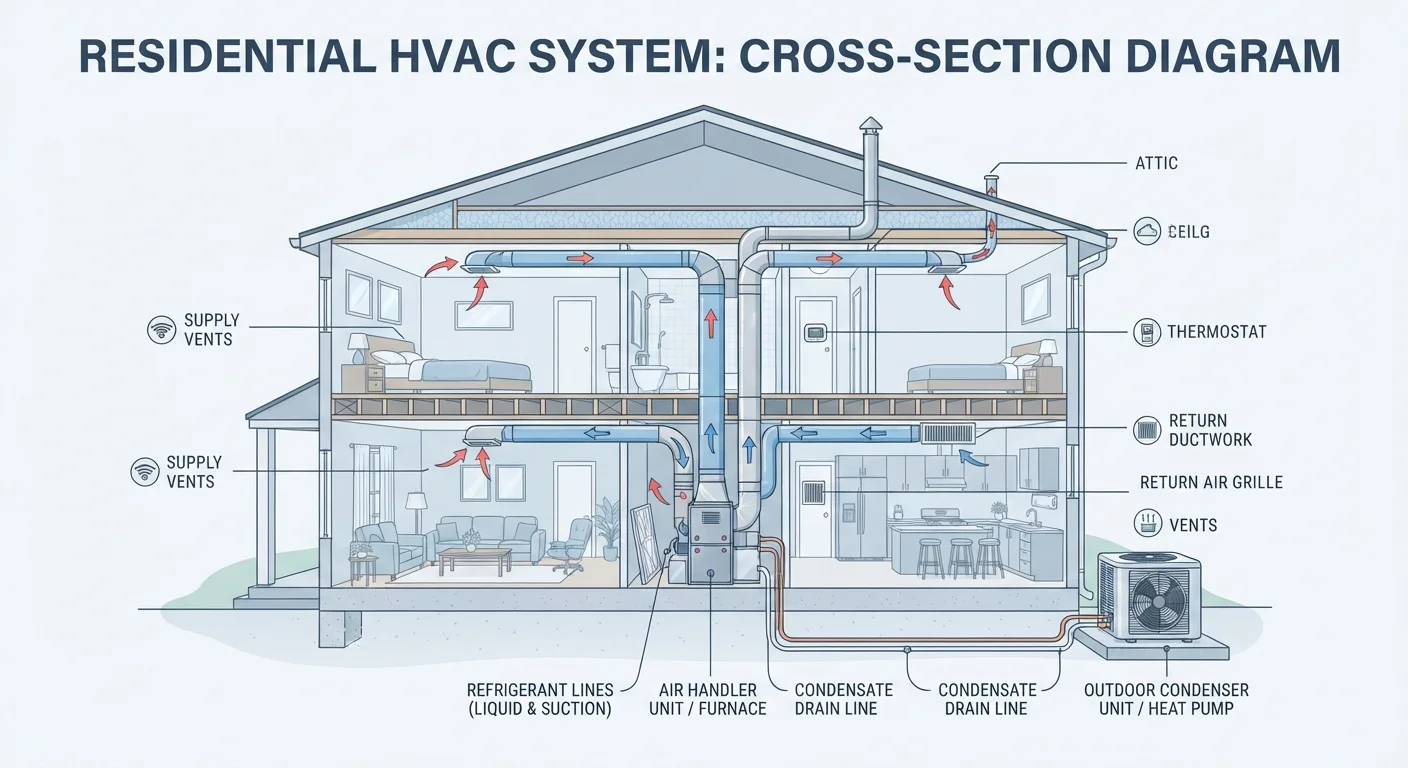
Air circulation in a residential HVAC system follows a continuous loop. Here's the basic sequence:
- Return vents pull room air from living spaces back to the air handler, typically located in a utility closet, basement, or attic.
- The air passes through a filter, which traps dust, pollen, pet dander, and other particulates before they reach the equipment.
- The filtered air moves across either a heat exchanger (in a furnace) or an evaporator coil (in an air conditioning or heat pump system), where temperature is adjusted.
- Supply vents - the registers on walls, floors, or ceilings - push conditioned air back into each room.
The thermostat monitors room temperature against your set point and signals the system to run or stop. When it calls for heating or cooling, a blower fan inside the air handler circulates air through this entire loop until the target temperature is reached.
Mark Your Filter Change Dates
Write the installation date on the side of each new filter with a marker. This makes it easy to see at a glance how long it's been in service without relying on memory. Setting a recurring phone reminder for every 30 to 60 days is another simple way to stay consistent.
Heating: Furnaces and Heat Pumps
The two most common residential heating sources work very differently. A gas furnace burns natural gas or propane in a sealed combustion chamber. Hot combustion gases pass through a heat exchanger, warming the surrounding air without mixing with it. That warm air is then blown through ducts. The combustion byproducts exit safely through a flue or exhaust pipe.
A heat pump doesn't generate heat at all - it moves it. Using refrigerant, it extracts thermal energy from outdoor air (even in cold weather) and transfers it indoors. In summer, the process reverses and the heat pump acts as an air conditioner. This makes heat pumps efficient across a wide range of climates, though very cold regions often pair them with a gas furnace for backup capacity.
Because HVAC equipment has a finite service life, understanding what type of system you have helps you anticipate replacement timelines and maintenance needs.
Cooling: How Heat Is Removed from Your Home
Air conditioning works on a principle of heat transfer, not cold-air generation. A chemical refrigerant cycles between the indoor evaporator coil and the outdoor condenser unit, alternately absorbing and releasing heat.
Inside, warm room air passes over the cold evaporator coil. The refrigerant absorbs that heat and evaporates into a gas. It then travels to the outdoor compressor, which pressurizes it and moves it to the condenser coil. There, the heat is released into the outside air, and the refrigerant returns to a liquid state to repeat the cycle. A secondary benefit: as warm air contacts the cold coil, moisture condenses out of it, reducing indoor humidity.
The quality of this process depends heavily on your home's envelope. Insulation quality and type directly affects how hard your cooling equipment has to work to maintain a set temperature.
Filters, Ducts, and the Parts You Interact With
The air filter is one of the few HVAC components homeowners regularly touch, and it has a significant impact on both system performance and indoor air quality. A clogged filter restricts airflow, forcing the blower to work harder and reducing the system's ability to heat or cool effectively. Most households benefit from checking filters monthly and replacing them on a schedule based on usage and environment.
Ductwork is the hidden infrastructure that makes the whole system function. Leaky or poorly insulated ducts can lose a meaningful portion of conditioned air before it ever reaches living spaces - a common source of uneven temperatures and higher energy use. Duct sealing and insulation are jobs for a qualified HVAC professional.
Staying on top of routine tasks - filter changes, coil cleaning, and seasonal checkups - is covered in detail in our seasonal home systems maintenance checklist. If you're considering upgrading your thermostat, see what actually changes when you add a smart thermostat to understand compatibility before purchasing.
This article is for general informational and educational purposes. For installation, repair, or work involving gas lines, refrigerant, or electrical components, always consult a licensed HVAC professional and verify local permit requirements.