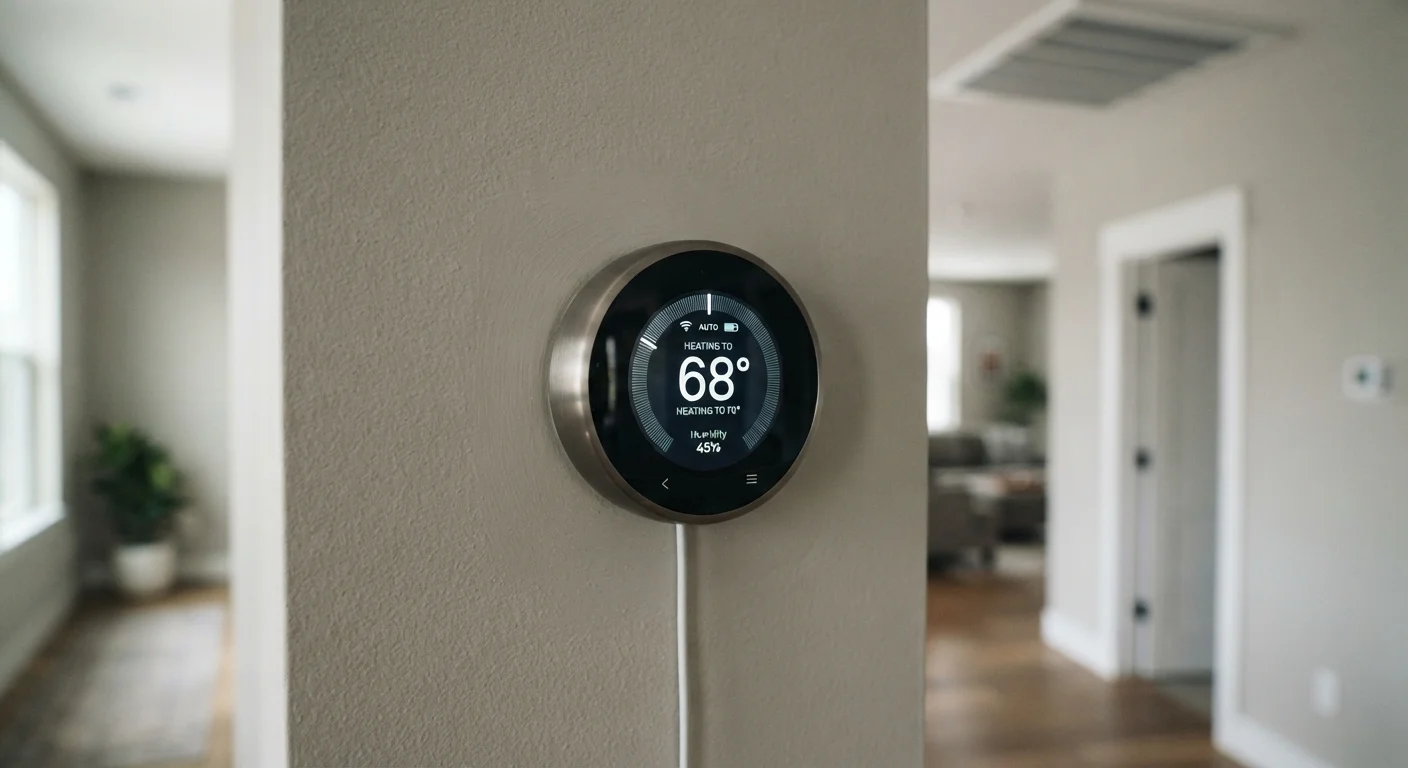
What a Smart Thermostat Actually Does
A smart thermostat sits at the interface between you and your HVAC equipment. It receives temperature inputs, follows a schedule you set, learns from your behavior, and sends signals to your heating or cooling system to run or stop. What it does not do is change how your furnace, air conditioner, or heat pump operates internally.
Think of it like a more responsive switch. Your furnace still burns the same fuel, your air conditioner still moves heat the same way - the thermostat just decides when to trigger those processes with greater precision. Understanding this distinction matters because it shapes realistic expectations about what upgrading actually delivers.
To understand how a thermostat fits into your home's broader systems, see a homeowner's map of core house systems.
~8%
Typical heating savings from setback thermostats
The U.S. Department of Energy estimates that turning your thermostat back 7-10°F for 8 hours per day can save roughly 8% annually on heating costs, depending on climate and usage patterns.
30-40%
Share of US homes with compatible C-wire wiring
Industry estimates suggest a significant portion of older US homes lack a dedicated C-wire, making pre-installation wiring verification an important step rather than an afterthought.
~42%
Share of home energy use from heating and cooling
According to the U.S. Energy Information Administration, space heating and cooling account for the largest single share of residential energy consumption in the United States.
Compatibility: The Critical First Step
Before any smart thermostat can improve how your HVAC runs, it has to be able to communicate with that system at all. Most standard central forced-air systems - gas furnaces, central air conditioners, and many heat pumps - use low-voltage wiring that smart thermostats are designed to work with. But the details matter.
System type: Single-stage systems (equipment that runs at one fixed output level) have broad compatibility. Multi-stage and variable-speed systems can unlock more nuanced thermostat features, but only with thermostat models that explicitly support them.
C-wire availability: The common wire provides constant power to the thermostat. Homes wired before the mid-2000s often lack one. Without it, some models will attempt workarounds that can interfere with equipment behavior - a known issue, not a marketing footnote.
Heat pumps and radiant systems: Heat pumps require thermostats that handle reversing valve signals. Radiant systems - which heat through floors or panels rather than air - are often incompatible with thermostats designed for forced-air. See how forced-air and radiant heating differ before assuming your system will work with any model.
Check Wiring Before You Commit
Before selecting a smart thermostat model, remove your current thermostat's cover and photograph the labeled wires. Most thermostat manufacturers provide online compatibility checkers where you can enter your wire labels and confirm which models will work. If you see unusual wiring or don't recognize the labels, an HVAC technician can identify your setup quickly and save you the cost of a return.
What Changes After Installation
Once a compatible smart thermostat is installed and configured, the practical differences tend to fall into three categories:
- Scheduling precision: Rather than fixed on/off times, smart thermostats adjust ramp-up and cooldown periods based on how your home heats or cools. This reduces the tendency to overshoot a target temperature and then cycle unnecessarily.
- Remote control and monitoring: You can adjust temperature from anywhere and review how long your system ran each day. That runtime data can surface patterns - like the system running longer than expected - that might indicate ductwork or equipment issues worth investigating.
- Occupancy response: Many models use phone location or motion sensors to shift to an energy-conserving mode when the home is empty, and restore comfort settings before you return. This is where the most meaningful energy impact typically comes from for households with irregular schedules.
It's worth noting that if your ductwork is leaking or poorly designed, a smart thermostat will not compensate for that loss - it will simply run an inefficient system on a smarter schedule.
What Doesn't Change - and Why It Matters
A smart thermostat cannot extend the life of aging HVAC equipment, improve an undersized system's ability to condition the space, or offset poor insulation. These are mechanical and structural realities that exist independently of thermostat choice.
Homeowners sometimes expect energy bills to drop sharply after installation. In homes where heating and cooling were already managed conservatively - temperatures adjusted manually when leaving, set back at night - the additional gains from automation tend to be modest. The technology primarily helps households that previously left systems running at fixed, unchanging settings.
Equipment age also matters in this context. A thermostat upgrade on a system near the end of its service life may deliver limited return before the equipment itself needs attention. Understanding the typical lifespan of major home systems can help you decide whether a thermostat upgrade makes sense given where your HVAC equipment is in its cycle.