What Insulation Actually Does
Insulation slows the movement of heat through your home's walls, ceilings, and floors. In winter, it keeps warmth inside. In summer, it blocks outdoor heat from entering. That single function - thermal resistance - is the basis for every material on this list.
Insulation is measured in R-value, which quantifies how well a material resists heat flow. A higher R-value means greater resistance. The appropriate R-value for any given space depends on climate zone, location in the home (attic insulation typically needs a higher R-value than walls), and local building codes. Because insulation works directly with how your home controls temperature, it's closely tied to how your heating and cooling equipment performs - see how your HVAC system actually works for that connection explained plainly.
| R-value of fiberglass batt (3.5 in.) | Approximately R-11 to R-15 (U.S. Department of Energy, general guidance) |
| R-value of closed-cell spray foam (per inch) | Approximately R-6 to R-7 (U.S. Department of Energy, general guidance) |
| Typical attic insulation target (Climate Zone 4-5) | R-38 to R-60 (U.S. Department of Energy zone recommendations) |
| Cellulose composition | 70-80% recycled paper fiber (Cellulose Insulation Manufacturers Association) |
| Insulation form types | Batts/rolls, loose-fill, spray foam, rigid board, mineral wool |
| Permits often required for | New insulation in finished spaces, spray foam installation (Varies by jurisdiction - verify with local building authority) |
Common Insulation Types and Where They're Used
Each insulation material has a different form, installation method, and ideal application. Understanding these basics helps you ask the right questions when planning a project.
Fiberglass Batts and Rolls
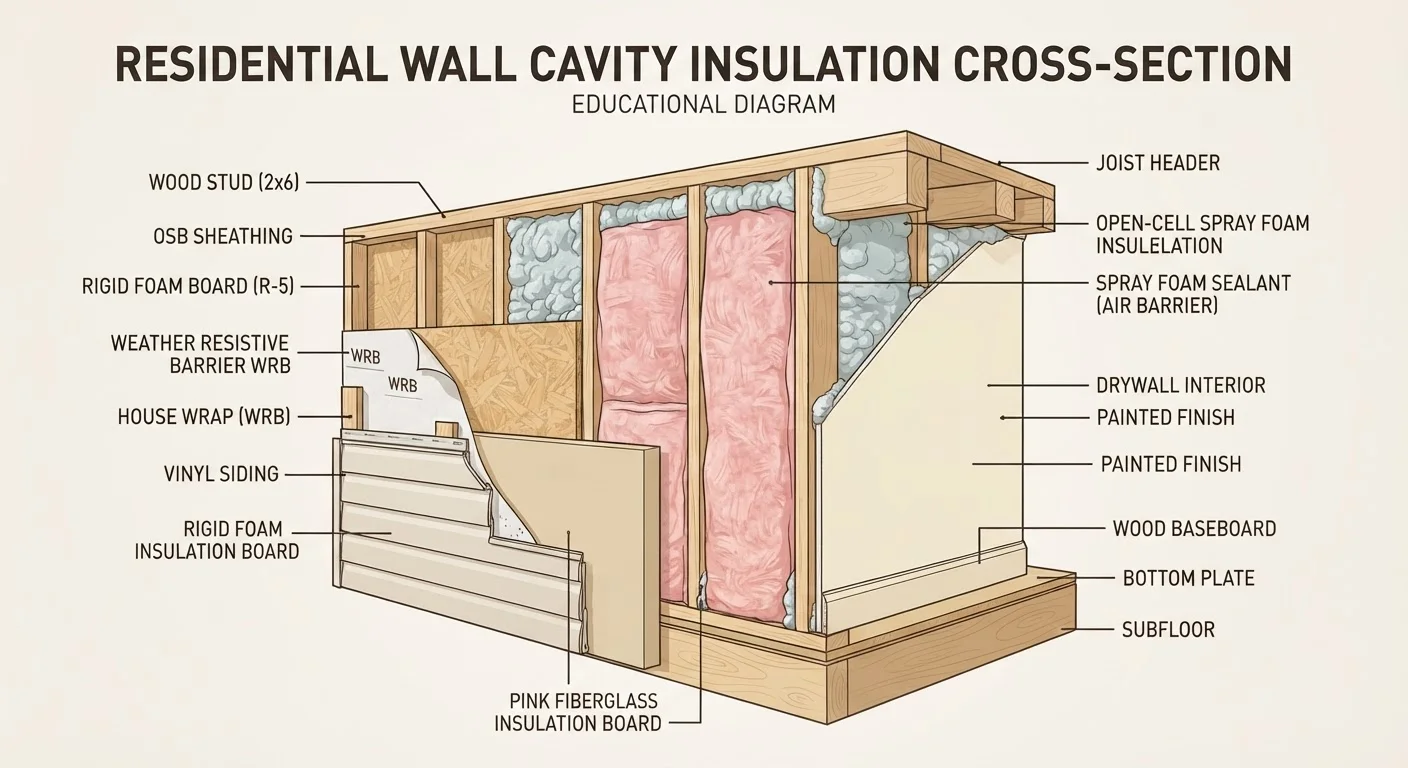
Fiberglass is the most widely recognized insulation form - those pink or yellow blankets pre-cut to fit standard stud and joist spacing. Batts are used in walls, attics, and floors. They're relatively straightforward to install in open cavities but perform best when fitted carefully without gaps or compression, both of which reduce effective R-value.
Blown-In (Loose-Fill) Insulation
Loose-fill insulation - made from fiberglass, cellulose, or mineral wool - is blown into place using specialized equipment. It's well suited to attic floors and irregularly shaped spaces where batts can't conform easily. Cellulose is made from recycled paper and treated for fire resistance. It can settle over time, which may reduce effective coverage.
Spray Foam Insulation
Spray polyurethane foam expands on contact to fill gaps, cracks, and irregular cavities. It comes in two main types: open-cell foam (softer, lower R-value per inch, vapor-permeable) and closed-cell foam (denser, higher R-value per inch, acts as a vapor barrier). Spray foam is often used in rim joists, cathedral ceilings, and areas where air sealing is as important as thermal resistance. Professional installation is standard - improper mixing or application can result in off-gassing or inadequate curing.
Rigid Foam Board
Rigid panels made from polystyrene (EPS or XPS) or polyisocyanurate provide continuous insulation with no framing interruptions. They're commonly applied to exterior walls, under roofing assemblies, and in basement walls. Rigid board adds R-value without taking up interior space, making it practical in retrofit situations. Most rigid foam requires a fire-rated covering (such as drywall) when used in living spaces - local codes vary, so verify requirements with a licensed contractor.
Mineral Wool (Rock Wool / Slag Wool)
Made from volcanic rock or industrial slag, mineral wool batts offer thermal performance similar to fiberglass but with notable fire resistance and some sound-dampening properties. It holds its shape well and is less prone to moisture absorption than fiberglass. Mineral wool is used in walls, attics, and around mechanical systems where fire resistance is a priority.
R-value
A measure of a material's resistance to heat flow. Higher R-values indicate better insulating performance. Required R-values vary by climate zone and building location (attic, wall, floor).
Thermal bridging
Heat loss that occurs when a more conductive material - like a wood or metal stud - bypasses insulation and creates a direct path for heat to escape. Continuous insulation (such as rigid board) helps reduce this.
Vapor barrier
A material that resists the passage of moisture vapor through walls or ceilings. Closed-cell spray foam inherently acts as a vapor barrier; other insulation types may require a separate barrier layer depending on climate.
Air sealing
The process of closing gaps, cracks, and penetrations in a building envelope to prevent uncontrolled airflow. Effective air sealing works alongside insulation - insulation alone does not stop air movement.
Open-cell foam
A type of spray foam where the cells remain open after curing, producing a softer, vapor-permeable material with a lower R-value per inch compared to closed-cell foam.
Closed-cell foam
A denser spray foam where cells are sealed after curing, providing a higher R-value per inch and acting as a vapor barrier. It is typically more expensive than open-cell foam.
For a side-by-side performance breakdown of these materials, see insulation types compared. And if you're thinking about how insulation fits within your home's broader systems, a homeowner's map of core house systems provides useful context.