How Insulation Is Measured: R-Value Basics
Before comparing materials, it helps to understand the common yardstick: R-value. R-value measures a material's resistance to heat flow - the higher the number, the more effective the insulation per inch of thickness. R-value requirements vary by climate zone and by location in your home; attics generally require higher values than walls, for example.
One important detail: R-value ratings assume correct installation. Compressed batts, gaps around penetrations, or missing vapor barriers can all reduce real-world performance significantly. For a broader overview of how these materials work in context, see this guide to common insulation materials.
| Fiberglass Batts | Spray Foam (Closed-Cell) | Rigid Board (XPS) | Cellulose | |
|---|---|---|---|---|
| R-value per inch | R-2.9 to R-3.8 | R-6 to R-7 | R-5 (typical) | R-3.2 to R-3.8 |
| Air sealing ability | Low (requires separate barrier) | High (expands into gaps) | Moderate (tape seams) | Moderate (dense-pack) |
| Typical application | Framed walls, attics, floors | Rim joists, rooflines, irregular spaces | Exterior sheathing, basements | Attic floors, retrofit walls |
| DIY feasibility | Generally accessible | Professional recommended | Moderate with proper tools | Requires blowing equipment |
| Relative cost | Lower | Higher | Moderate to higher | Lower to moderate |
| Moisture resistance | Low | High (closed-cell) | High | Low - avoid wet areas |
Fiberglass: Familiar and Accessible
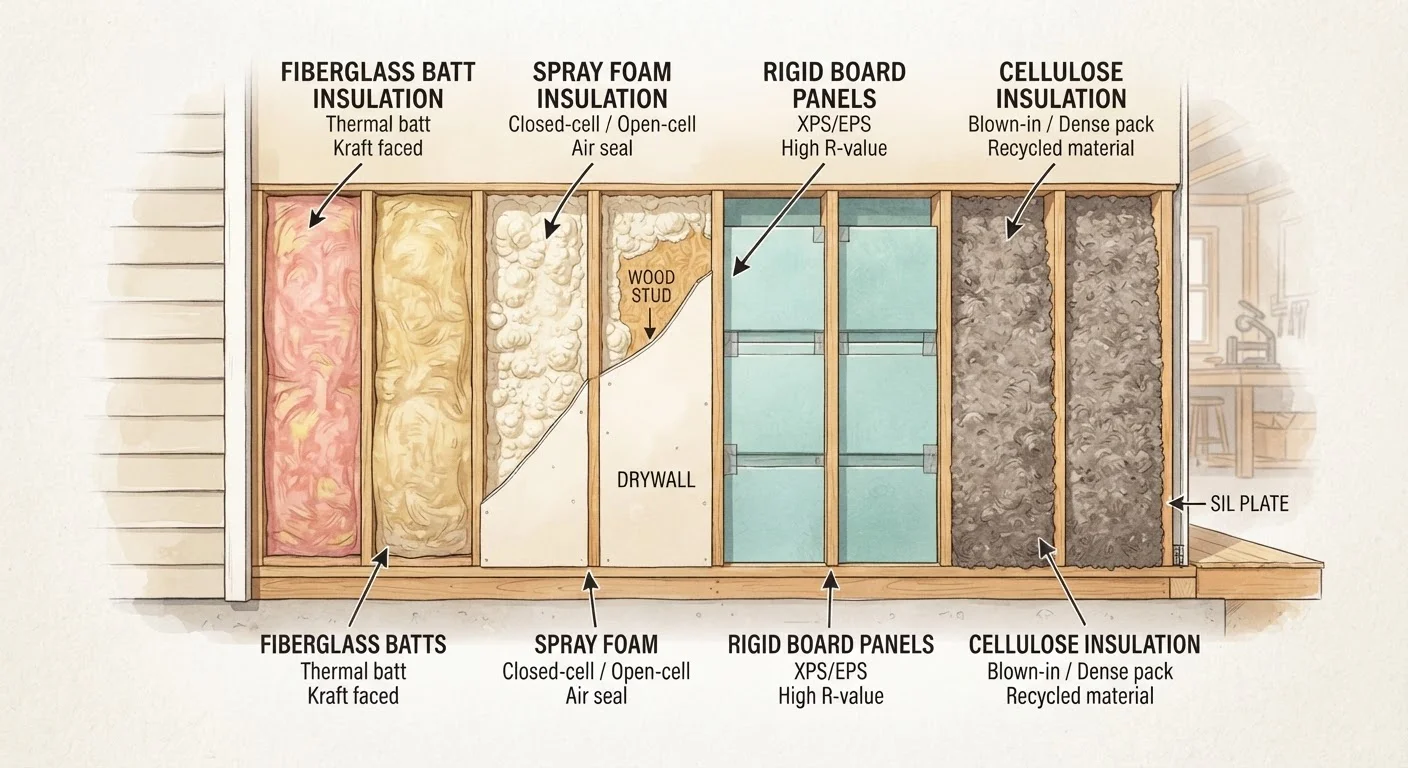
Fiberglass insulation - available as batts, rolls, or loose fill - is one of the most common choices in US residential construction. Batts are cut to fit standard stud and joist spacing, making them accessible for homeowners comfortable with basic DIY work. R-value typically runs R-2.9 to R-3.8 per inch, depending on density.
The main limitation is air leakage. Fiberglass slows conductive heat transfer but does not block air movement on its own, meaning it works best when paired with a properly sealed air barrier. Gaps around electrical boxes, pipes, or irregular framing can undercut performance noticeably. Loose-fill fiberglass, blown in by machine, handles irregular cavities more evenly than batts.
Fit Matters as Much as R-Value
When installing fiberglass batts, ensure each batt fills the cavity fully without compression or gaps around edges. A batt that's been compressed to fit a shallower space will have a lower effective R-value than its label indicates. Take time to cut around obstructions cleanly and use appropriate widths for your stud spacing.
Spray Foam: Air Sealing and Insulation Combined
Spray polyurethane foam (SPF) comes in two main forms: open-cell and closed-cell. Open-cell foam is softer and more vapor-permeable, with an R-value around R-3.5 per inch. Closed-cell foam is denser, offers R-6 to R-7 per inch, and also functions as a vapor retarder.
The significant advantage of spray foam is its ability to seal air gaps as it expands - something no batt or board product can match in irregular spaces. This makes it popular in rim joists, roof decking, and areas with complex geometry. The trade-off is cost: spray foam is typically the most expensive insulation option, and professional installation is strongly recommended due to the chemicals involved. Proper ventilation and protective equipment are required during application.
If you're also evaluating how insulation interacts with your heating system, this comparison of forced air and radiant heat provides useful context.
Rigid Board: High Performance in Thin Profiles
Rigid foam board - available in expanded polystyrene (EPS), extruded polystyrene (XPS), and polyisocyanurate (polyiso) - offers R-values ranging from approximately R-3.8 (EPS) to R-6.5 (polyiso) per inch. Its rigidity makes it useful in applications where batts or blown insulation won't stay in place, such as exterior wall sheathing, under-slab insulation, and basement wall assemblies.
Rigid board does not air-seal on its own; seams between panels need to be taped or foamed to reduce air infiltration. It is also moisture-resistant, which is part of why XPS is commonly used in below-grade and crawl space applications. Most rigid foam requires a fire-rated covering (such as drywall) when installed in interior living spaces - local building codes specify this, and it's worth verifying requirements with your jurisdiction before installation.
Cellulose: Recycled Content and Good Coverage
Cellulose insulation is made primarily from recycled paper treated with fire retardants. It is blown in as loose fill, typically achieving R-3.2 to R-3.8 per inch. Because it conforms to irregular shapes and can be dense-packed into existing wall cavities without major demolition, it is a practical option for retrofitting older homes.
Cellulose's relatively high density gives it better resistance to air movement than standard fiberglass batts - though it still benefits from a sealed air barrier. One consideration is moisture: if cellulose becomes saturated (from a leak, for example), it can settle and lose R-value. It should not be used in areas with persistent moisture problems without addressing the moisture source first.
Installation requires blowing equipment, which can often be rented or is included in contractor services. Settled cellulose in attics should be checked periodically, as some settling is normal over time and may reduce installed thickness below the intended depth.
Permits and Codes Apply to Insulation Work
Some insulation projects - particularly in new construction, major retrofits, or when changing a roof assembly - may require permits or inspections under local building codes. Requirements vary by municipality and project scope. Always check with your local building department before starting significant insulation work, and use licensed contractors for spray foam applications involving hazardous chemicals.