
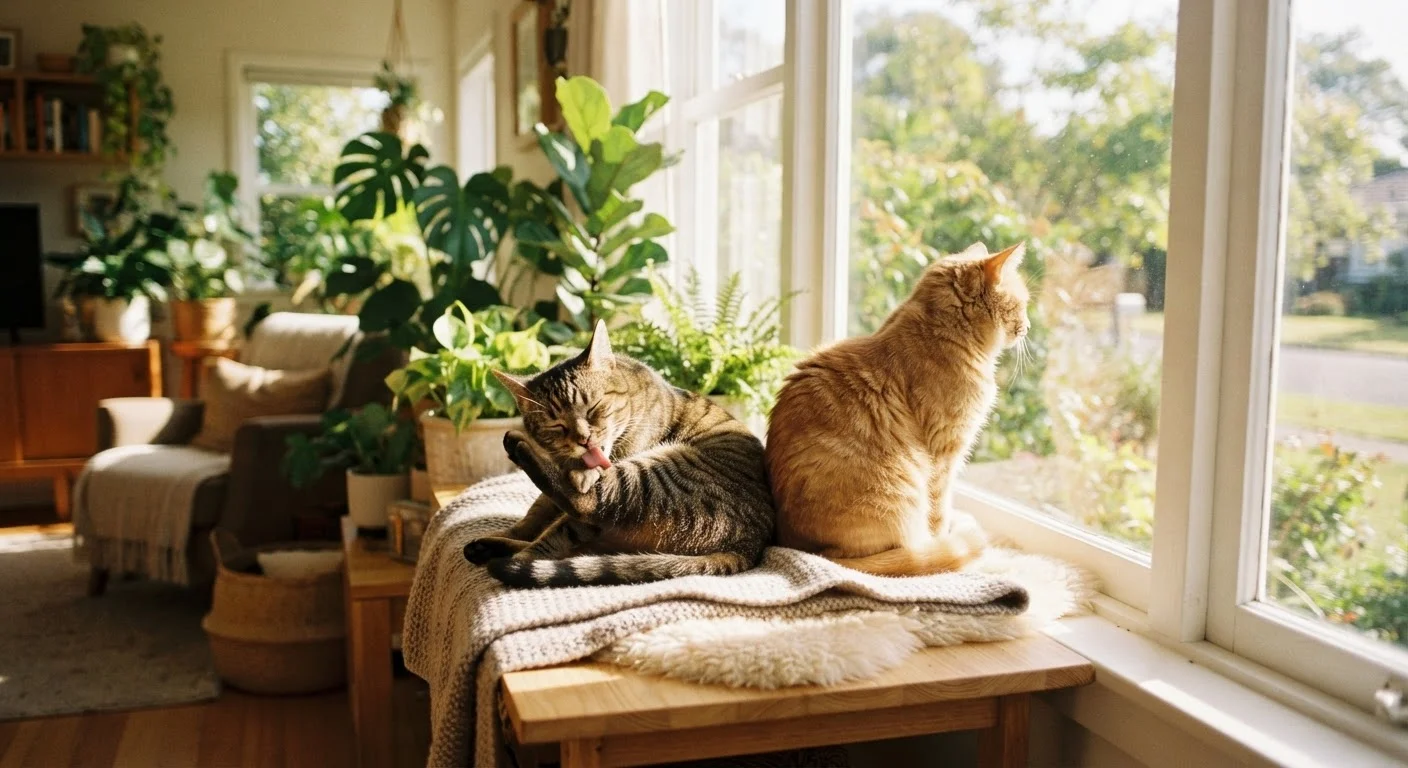
Why Multi-Cat Dynamics Are Structurally Different
Adding a second or third cat to a household doesn't simply multiply the companionship - it introduces a fundamentally different social structure that cats must navigate without the instinctual tools that pack animals use. Cats evolved as solitary hunters with loosely overlapping home ranges. In a domestic setting, they're asked to share fixed territory, resources, and human attention, often with animals they didn't choose as companions.
Cats Are Not Inherently Social
Unlike dogs, domestic cats evolved as solitary hunters. While many cats do form affiliative bonds with housemates, sociability is highly individual and cannot be assumed. Some cats thrive in multi-cat homes; others remain chronically stressed regardless of management efforts. Recognizing this upfront helps owners set realistic expectations and respond appropriately when bonding doesn't happen on a human timeline.
This matters because many owners assume that conflict or avoidance between cats reflects a personality problem that will resolve with enough time. More often, the problem is structural - not enough space differentiation, not enough resources, or an introduction process that moved too quickly. Understanding feline body language helps owners distinguish tension from tolerance before small friction becomes entrenched conflict.
The Best Practices for Resource Management
Most multi-cat conflict traces back to competition over predictable, finite resources. The practical solution is straightforward: increase supply and distribute it spatially so no single cat can control access. The following practices form the foundation of a lower-conflict multi-cat home.
Apply the 'n+1' rule for all key resources.
Resource guarding is the most common driver of inter-cat conflict. Providing one more litter box, food bowl, and water source than the number of cats prevents any individual from monopolizing access. Distributed resources remove the need for cats to compete or negotiate, which dramatically reduces tension.
Use a scent-first introduction protocol for all new cats.
Cats read their world primarily through scent. Allowing cats to exchange scent via bedding or a shared doorway before any visual contact gives them time to process the newcomer as non-threatening. Skipping this step and forcing visual or physical contact too early frequently causes lasting negative associations between cats.
Create vertical territory through cat trees, shelves, and elevated pathways.
Cats naturally partition space vertically, not just horizontally. Increasing usable vertical surface area effectively expands territory without requiring more floor space. High perches give subordinate cats escape routes and observation points, reducing the chance that a more confident cat corners or intimidates them.
Feed cats separately to eliminate mealtime competition.
Shared feeding bowls create predictable tension points, especially in households with cats of different ages, appetites, or dietary needs. Separate feeding locations reduce guarding behavior and allow each cat to eat at a comfortable pace. This is especially important when one cat is on a prescription diet or is significantly older.
Identify and monitor early warning signs of chronic stress.
Inter-cat conflict isn't always loud. Subtle signs - hiding, inappropriate elimination, over-grooming, or reduced appetite - can indicate ongoing stress that isn't expressed through overt fighting. Addressing these signals early prevents escalation and protects individual cat welfare. See our guide to stress signals in cats for a detailed breakdown of what to watch for.
Schedule individual daily interaction with each cat.
Cats that compete for owner attention are more likely to redirect frustration toward each other. Dedicated one-on-one play and interaction sessions with each cat reduce social rivalry and help owners track individual behavioral baselines - which is crucial for catching early stress or health changes.
For households considering whether to add another pet entirely, our honest look at small pet tradeoffs covers how to weigh the real responsibilities involved before committing.
Enrichment as Conflict Prevention
Boredom and under-stimulation amplify inter-cat friction. Cats with insufficient outlets for predatory behavior redirect that energy toward housemates. A well-enriched environment gives each cat meaningful things to do independently, reducing the frequency of unwanted social encounters. Our article on indoor cat enrichment covers the full range of strategies for meeting instinctual needs inside.
Rotate toys regularly to maintain novelty, and ensure each cat has at least one designated retreat space - a covered bed, a box, or a shelf - where they are unlikely to be disturbed by other cats or people. For senior cats navigating a multi-cat household, age-related care adjustments become especially relevant, as older cats typically need quieter, more predictable access to all resources.
This article is for general informational purposes only and does not constitute veterinary advice. If your cats are experiencing significant conflict or showing signs of stress-related health changes, consult a licensed veterinarian or certified feline behavior consultant.