Why Oil Degrades - and Why It Matters
Engine oil has one primary job: keep metal surfaces from grinding against each other. It also carries heat away from critical components, suspends combustion byproducts, and helps seal small gaps between piston rings and cylinder walls. The problem is that doing this job slowly destroys the oil itself.
Heat breaks down the hydrocarbon chains that give oil its lubricating properties. Combustion gases sneak past piston rings and contaminate the oil with acids and moisture. Fine metallic particles from normal engine wear accumulate over time. Additives that neutralize acids and prevent foaming get used up. The result is oil that becomes thicker, more corrosive, and far less protective than when it was fresh.
This is why a fixed interval exists - not as an arbitrary service upsell, but because degraded oil genuinely accelerates engine wear. For a broader view of how oil fits into your overall service schedule, see your vehicle's scheduled maintenance plan.
7,500-10,000 mi
Typical modern oil change interval
Many automakers now specify intervals of 7,500 to 10,000 miles for vehicles using full synthetic oil under normal driving conditions, per manufacturer owner's manuals.
~30%
Viscosity loss in severely degraded oil
Industry testing has shown that oil operating under severe-duty conditions can lose significant viscosity - reducing its ability to maintain a protective film between metal surfaces.
1 per year
Minimum recommended oil change frequency
Most manufacturers recommend at least one oil change annually regardless of mileage, because oil degrades over time even in low-use vehicles.
Reading the Dipstick: Level, Color, and Texture
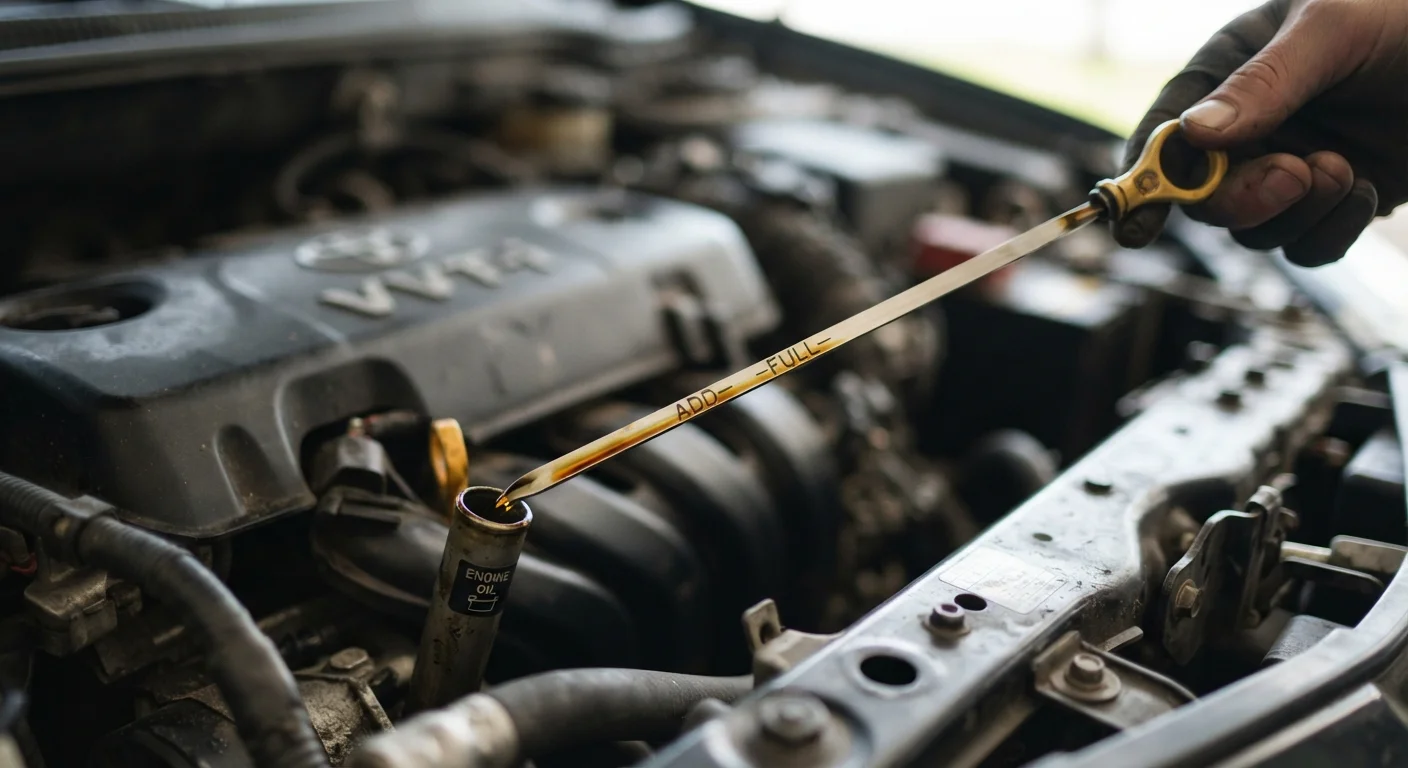
The dipstick gives you two distinct pieces of information: how much oil is in the engine and a rough indication of its condition. These are separate issues that point to different problems.
To check correctly, park on level ground, let the engine cool for a few minutes, pull the dipstick out fully, wipe it clean with a lint-free cloth, reinsert it all the way, then pull it out again. The oil film should sit between the two marks - typically labeled MIN and MAX or marked with hatching. Oil that reads at or below MIN is a low-level situation, not necessarily a degradation problem. Low oil can mean normal consumption (some engines burn a small amount of oil, especially as they age), or it can signal a leak. Either way, the level needs addressing.
Color and texture tell a different story. Fresh oil is typically amber and translucent. As it ages it darkens, which is normal. However, oil that looks gritty when rubbed between your fingers, has a milky or frothy appearance (which can indicate coolant contamination), or smells noticeably burnt has degraded beyond its effective service life. A qualified mechanic can help diagnose the underlying cause if you notice anything unusual.
Check the Dipstick Between Service Appointments
Don't wait until a dashboard warning or your next scheduled service to look at your oil. A quick dipstick check once a month - especially before long trips - takes under two minutes and can catch a low level or unusual contamination early. Make it part of the same habit as checking tire pressure.
Decoding Viscosity Ratings
The numbers on an oil container - such as 5W-30 or 0W-20 - are viscosity ratings set by the Society of Automotive Engineers (SAE). Viscosity describes how readily a fluid flows; higher numbers mean thicker oil.
The number before the W (which stands for winter) indicates the oil's cold-start flow behavior. A lower number here means the oil flows more easily at low temperatures, which is critical for protecting the engine during those first seconds after a cold start when oil pressure is still building. The number after the W describes viscosity at normal engine operating temperature - roughly 212°F (100°C).
Using the wrong viscosity can cause problems in both directions. Oil that's too thin at operating temperature may not maintain adequate pressure; oil that's too thick in cold weather may not circulate quickly enough at startup. Your owner's manual specifies the correct grade for your engine and climate range. Deviating from that spec without guidance from a qualified mechanic is generally not advisable. For more on how oil formulation affects performance, see synthetic vs. conventional motor oil.
How Driving Conditions Change the Equation
Manufacturer intervals are typically based on what engineers classify as normal driving - a mix of highway and urban miles with moderate temperatures. A significant portion of US drivers operate under what manufacturers call severe service conditions, which include:
- Frequent short trips under 5 miles, where the engine never fully warms up
- Stop-and-go city traffic for extended periods
- Towing or hauling heavy loads regularly
- Driving in extreme heat or very cold climates
- Extended idling (common in delivery or rideshare driving)
Under these conditions, oil degrades faster because the engine runs harder, generates more heat, and - in short-trip situations - doesn't get hot enough to burn off accumulated moisture. Many manufacturers publish a separate, shorter interval specifically for severe service. Check your owner's manual for both schedules and assess which one matches your real-world driving.
Low-mileage drivers face a different challenge: time rather than usage. If your car sits for months between drives, the oil can still oxidize and absorb moisture. Keeping a car in good shape when you barely drive it covers why a time-based interval - typically once per year - matters even when the odometer barely moves.
Oil Life Monitors and When to Trust Them
Many vehicles sold in the past 15 years include an oil life monitoring system (OLMS). Despite the name, these systems don't sample the actual oil. Instead, they use algorithms that factor in engine speed, temperature, load, and time to estimate how much useful life remains in the oil. When the estimate drops to a certain threshold, a dashboard notification appears.
These systems are generally reliable for normal driving, but they have limitations. They assume you're using the oil grade and type specified in your manual. They can't detect contamination from a coolant leak or an abnormally high rate of fuel dilution. And some older implementations are simply mileage-based counters with a different label.
The practical takeaway: treat an OLMS alert as a firm prompt to act, not a suggestion to delay. Don't reset the monitor without actually changing the oil. And regardless of what the monitor shows, a periodic dipstick check between service appointments takes less than two minutes and gives you real-time information the algorithm cannot. For the full picture of what fluid checks belong in your routine, see this driver's reference on vehicle fluids.