
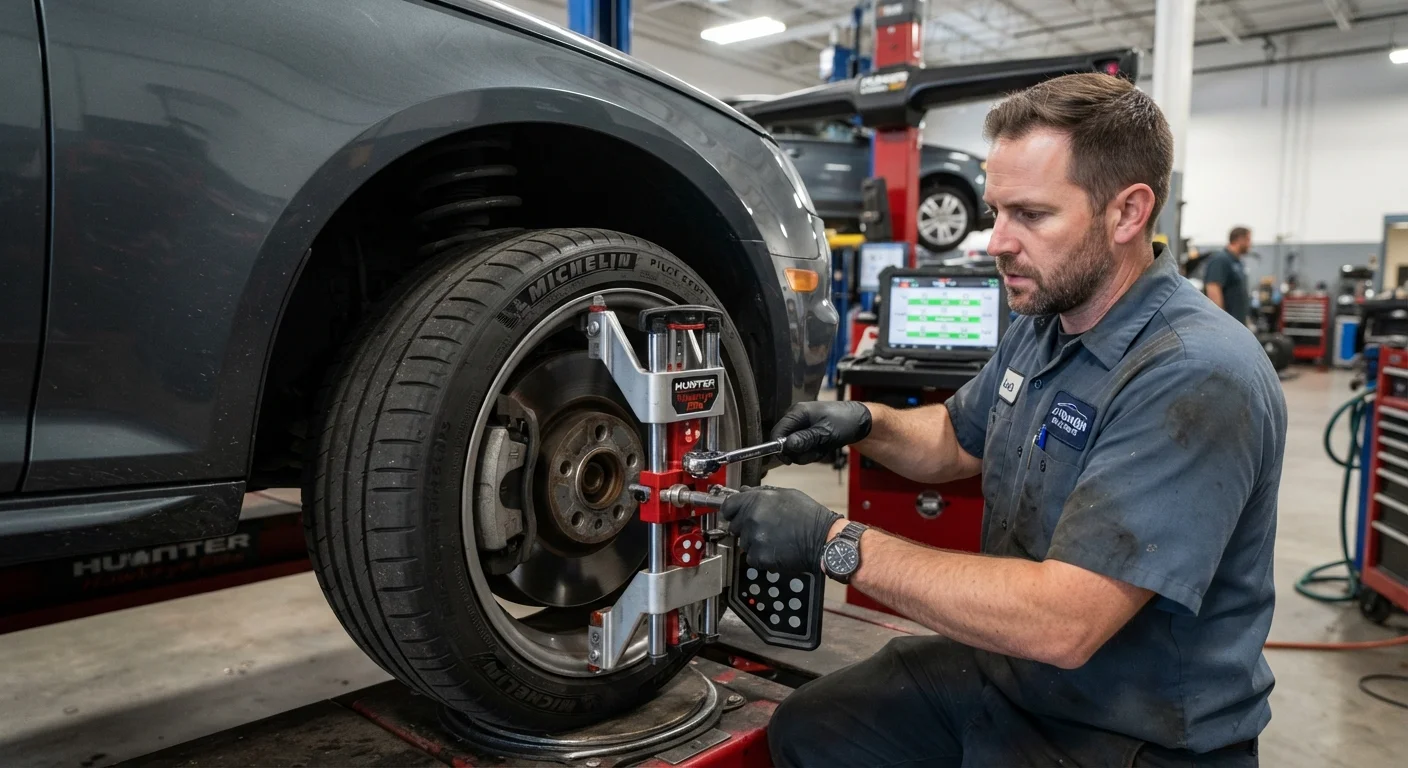
What Wheel Alignment Actually Does
Every vehicle is engineered with precise specifications for how its tires should be angled relative to the road and to each other. These angles - camber (the inward or outward tilt of the tire), toe (whether tires point slightly inward or outward), and caster (the angle of the steering axis) - determine how effectively your tires grip the pavement, how the car tracks in a straight line, and how it responds when you steer.
When those angles drift out of spec - from road impacts, worn suspension components, or simply time - your tires no longer contact the road as intended. The result is uneven wear: one edge of the tread degrades faster than the other. Left unaddressed, a moderately misaligned vehicle can wear out a tire in a fraction of its expected lifespan. You may also notice increased fuel consumption, because tires fighting incorrect angles create additional rolling resistance the engine must overcome.
It's worth noting that alignment doesn't always produce dramatic symptoms. A vehicle may pull subtly to one side, or the steering wheel may sit slightly off-center on a straight road. These minor signs are easy to dismiss - until the tread wear becomes impossible to ignore. Common car maintenance myths can sometimes lead drivers to overlook these early warnings.
When to Check Alignment Between Scheduled Services
You don't have to wait for your next service interval if you hit a large pothole, strike a curb, or are involved in even a minor collision. Any of these events can shift alignment angles noticeably. Getting an alignment check promptly after a significant impact can prevent weeks of accelerated, uneven tire wear before your next scheduled visit.
Why Tire Rotation Matters More Than Most Drivers Realize
Tires don't wear at the same rate across all four positions on a vehicle. Front tires on a front-wheel-drive car, for example, bear the load of steering, acceleration, and braking simultaneously - they wear faster than rear tires. On rear-wheel-drive vehicles, the rear tires handle the driving force and tend to wear differently from the fronts. Even on all-wheel-drive vehicles, torque distribution differences mean wear is rarely perfectly equal.
Tire rotation solves this by periodically redistributing each tire's workload. Moving a heavily stressed front tire to a rear position gives its tread a chance to wear more gradually. Over the life of the tire, consistent rotation keeps tread depth closer to uniform across all four tires, which improves handling balance, wet-weather traction, and the likelihood that all four tires reach the end of their useful life at the same time - simplifying replacement decisions.
~$150
Average cost of a four-wheel alignment
Industry service data suggests a four-wheel alignment typically costs between $100 and $200 at independent shops, far less than a full set of replacement tires.
5,000-7,500 mi
Typical tire rotation interval
Most vehicle manufacturers specify a rotation interval in this range; many drivers align it with their oil change schedule for convenience.
~10%
Potential fuel economy impact from rolling resistance
The U.S. Department of Energy notes that tire-related factors, including inflation and condition, can influence fuel economy by roughly 0.5% to 3% per underinflated or degraded tire, with compounding effects from misalignment.
The rotation pattern that works for your vehicle depends on its drivetrain and whether your tires are directional (designed to spin only one way) or non-directional. Your owner's manual is the authoritative source for the correct pattern. If you're also thinking about how other low-use factors affect tires, see what happens to tires when a car sits idle.
How These Services Connect to Overall Handling
Handling is the sum of many interacting systems - suspension geometry, tire pressure, tread depth, and alignment all play a role. A vehicle with properly aligned wheels and evenly worn tires simply responds more predictably: it tracks straight without driver input, steers with consistent effort, and maintains composure during emergency maneuvers.
Misalignment and uneven wear undermine that predictability in ways that can matter in real driving situations. A tire worn thin on one shoulder has less grip on that portion of its contact patch, which can affect how the vehicle behaves in a corner or during sudden braking. These effects are often gradual enough that drivers adapt without realizing handling has degraded.
Maintaining correct tire pressure alongside regular alignment checks and rotation creates a system where each element supports the others. And integrating both services into a broader maintenance schedule - as outlined in a scheduled maintenance plan - is the most practical way to stay on top of them without guesswork.
Schedule Both Services Together When Possible
Many shops offer alignment checks when you bring a vehicle in for rotation, and combining them in one visit saves time. Since both services address how tires contact the road, having them done together makes it easier to identify whether any new wear pattern is alignment-related or rotation-interval-related - information that helps you maintain a more accurate service history.
This article provides general automotive information for educational purposes. For diagnosis or service recommendations specific to your vehicle, consult a qualified mechanic or refer to your owner's manual.