
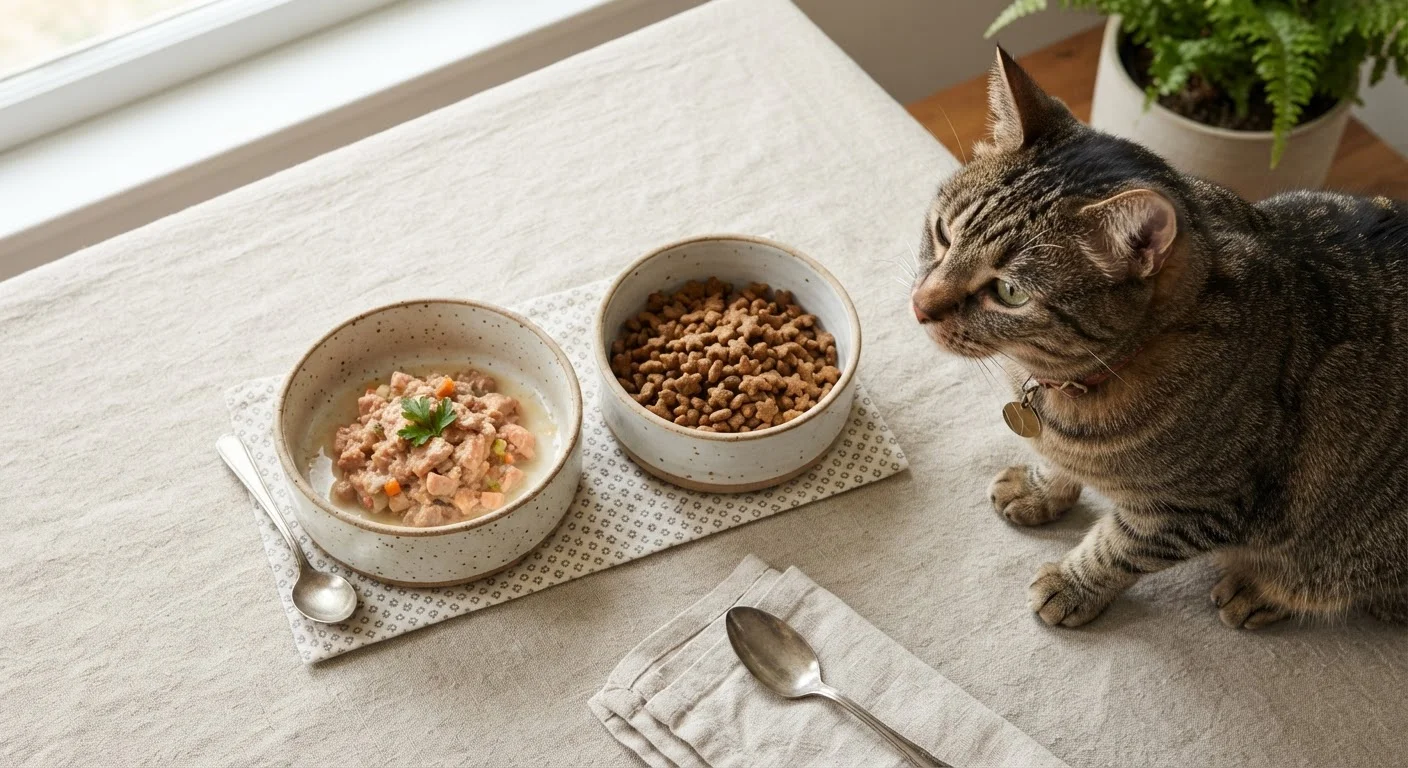
Why Feeding Format Matters More Than You Might Expect
Most cat owners choose a feeding format based on habit, cost, or what their cat will tolerate - and that's a reasonable starting point. But format isn't just a packaging preference. Wet and dry food differ substantially in moisture content, caloric density, ingredient composition, and how well they fit a cat's biological design.
Cats are obligate carnivores that evolved in arid environments. Their ancestors obtained most of their water from prey, not from a water bowl. This evolutionary background means cats have a naturally low thirst drive compared to dogs or humans. As a result, the moisture content of their food plays a more significant role in overall hydration than it does for many other animals. Our article on feline hydration explores this dynamic in depth.
Understanding the real trade-offs between wet and dry formats helps owners make deliberate choices rather than defaulting to convenience alone.
| Criterion | Wet (Canned) Food | Dry (Kibble) Food |
|---|---|---|
| Moisture content | 70-80% | ~10% |
| Protein level (typical) | Higher | Moderate |
| Carbohydrate content | Lower | Higher |
| Caloric density | Lower per gram | Higher per gram |
| Convenience | Requires refrigeration after opening | Shelf-stable, easy to store |
| Palatability | Generally higher aroma appeal | Variable by formula |
| Dental cleaning effect | Minimal | Minimal (evidence weak) |
| Cost per calorie | Generally higher | Generally lower |
| Urinary health support | Stronger (via hydration) | Weaker without added water intake |
Wet Food: Moisture, Palatability, and the Prey-Diet Connection
Canned cat food typically contains 70-80% moisture, compared to roughly 10% in dry kibble. That difference is substantial. A cat eating exclusively wet food takes in a meaningful volume of water with every meal, which helps support kidney function, reduces urinary concentration, and can lower the risk of urinary tract issues - a concern that affects a notable proportion of domestic cats.
Wet food also tends to be higher in protein and lower in carbohydrates than most dry formulas, more closely mirroring what cats would consume as predators. Many cats find wet food more palatable, which can be especially useful for older cats with diminished appetite or cats recovering from illness. For senior cats specifically, this matters - for context on how nutritional needs shift with age, see our guide on the senior cat transition.
The practical downsides are real: open cans must be refrigerated and used within 24-48 hours, cost per calorie is generally higher than kibble, and meal-feeding requires more owner involvement than leaving out dry food.
70-80%
Moisture content in typical wet cat food
Compared to roughly 10% in dry kibble - a gap that has meaningful implications for daily feline hydration.
~1 in 10
Cats affected by urinary tract disease
Feline lower urinary tract disease is among the most common reasons cats are brought to veterinary clinics in the US.
Low
Cats' innate thirst drive compared to other species
Research on feline physiology shows cats do not compensate well for low dietary moisture by drinking more water voluntarily.
Dry Food: Convenience, Caloric Density, and the Dental Health Myth
Kibble's appeal is largely practical. It stores easily at room temperature, is calorie-dense (meaning smaller volumes deliver adequate energy), and suits free-feeding arrangements where an owner refills the bowl once or twice a day. For multi-cat households or owners with demanding schedules, these are genuine advantages.
One claim worth scrutinizing is that dry food cleans cats' teeth. The evidence for this is weak. Most cats swallow kibble whole or shatter it with minimal chewing - neither action provides meaningful plaque removal. Veterinary dental organizations generally recommend tooth brushing or specially designed dental products rather than relying on food texture for oral health.
Dry food's higher carbohydrate content is worth noting. Cats have limited ability to digest large amounts of starch efficiently, and some veterinary nutritionists have raised questions about whether high-carbohydrate dry diets contribute to obesity or metabolic issues in sedentary indoor cats. The evidence is not conclusive, but it warrants awareness, particularly for indoor-only cats who may already face activity and enrichment challenges.
Combining Both: What a Mixed Feeding Approach Looks Like
Many cat owners and veterinary professionals favor a combined approach - wet food for one or more meals per day and dry food offered as a supplement or for free-access grazing. This strategy can capture the hydration benefits of wet food while preserving some of the convenience of kibble.
There is no universal formula. The right ratio depends on your cat's weight, health status, activity level, and individual preferences. A cat prone to obesity may need tighter portion control regardless of format, while a cat with early kidney disease may benefit from maximizing wet food intake. Transitioning between formats should be done gradually to avoid digestive upset - sudden changes can cause gastrointestinal discomfort in cats.
Transitioning Between Feeding Formats
If you decide to shift from dry-only to a mixed or wet-primary diet, introduce the new format gradually over 7-10 days. Start by mixing a small amount of wet food into the existing kibble and increase the proportion incrementally. Abrupt changes can cause digestive upset and may make a cat resistant to the new format. Cats with food sensitivities or digestive conditions warrant extra caution - consult your vet before making the switch.
If you are comparing cat nutrition approaches to how canine diets are structured, it is worth noting that cats and dogs have meaningfully different nutritional requirements. Our article on dog nutrition fundamentals covers the canine side in detail.
This article provides general information about cat feeding formats and is not a substitute for personalized veterinary advice. Consult your veterinarian before making significant changes to your cat's diet, particularly if your cat has an existing health condition.