Why Comparing Budgeting Methods Matters
A budget is simply a plan for your money - but the method you choose shapes how much time it takes, how well it holds up under pressure, and whether you'll stick with it. Before diving into specifics, it helps to understand the key budgeting terms that appear across every method, such as discretionary spending, fixed expenses, and cash flow.
If you've never built a budget before, the ground-up guide to your first budget is worth reviewing alongside this comparison. Here, we focus on five widely recognized approaches and what makes each one distinct.
The Five Methods at a Glance
Each method below reflects a different philosophy about where discipline should be applied - at the moment money arrives, at each spending category, or at the end of the month.
| Pay-Yourself-First | 50/30/20 Rule | Zero-Based | Envelope | Values-Based | |
|---|---|---|---|---|---|
| Core principle | Save before spending | Proportional category splits | Every dollar assigned | Cash caps per category | Spend by personal priority |
| Time commitment | Low - automate and go | Low to moderate | High - monthly rebuild | Moderate | Moderate - requires reflection |
| Tracking detail | Minimal | Category-level | Highly granular | Category-level | Priority-level |
| Works well with variable income | Somewhat - adjust transfer | Yes - scales with income | Challenging | Somewhat | Yes - flexible by design |
| Savings emphasis | Very high - first priority | Built-in at 20% | Defined each month | Requires an envelope | Depends on priorities |
| Ideal for beginners | Yes | Yes | Less so | Moderate | Less so |
Details and trade-offs for each method are covered in the sections that follow.
Pay-Yourself-First
How it works: Before paying any bills or spending on discretionary items, you transfer a set amount into savings or an investment account. Whatever remains covers living expenses.
Best suited for: People with stable, predictable incomes who struggle to save consistently. Automating the transfer removes the temptation to spend first and save what's left.
Trade-offs: It does not guide how the remaining money gets spent - overspending on daily expenses is still possible. Those with tight margins may find the method creates cash-flow stress if the savings amount is set too high initially.
Start With a Savings Rate You Can Sustain
When using pay-yourself-first, many financial educators suggest beginning with a modest percentage - even 5% or 10% of take-home pay - and increasing it gradually as your budget adjusts. An overly ambitious initial transfer can lead to dipping into savings to cover regular expenses, which defeats the purpose. Consistency over time matters far more than the size of the first transfer.
The 50/30/20 Rule
How it works: Take-home income is divided into three broad categories - roughly 50% toward needs (housing, utilities, groceries), 30% toward wants (dining out, entertainment), and 20% toward savings and debt repayment.
Best suited for: Those who want a clear framework without tracking every purchase. Its proportional nature means it scales with income changes automatically.
Trade-offs: The percentages are guidelines, not rules - high-cost-of-living areas may push needs well above 50%, forcing adjustments to the other categories. For a deeper comparison of this approach against a more granular alternative, see 50/30/20 vs. zero-based budgeting.
Zero-Based Budgeting
How it works: Every dollar of monthly income is assigned a specific job - expenses, savings, debt payments - until income minus allocations equals zero. No dollar goes unassigned.
Best suited for: Detail-oriented budgeters, those actively paying down debt, or anyone who wants full visibility into spending patterns. It requires a new plan each month, which keeps the budget current.
Trade-offs: Time-intensive; irregular or variable income makes monthly planning harder. Freelancers and gig workers may find the strategies for irregular income more practical as a starting point.
Envelope Budgeting and the Values-Based Approach
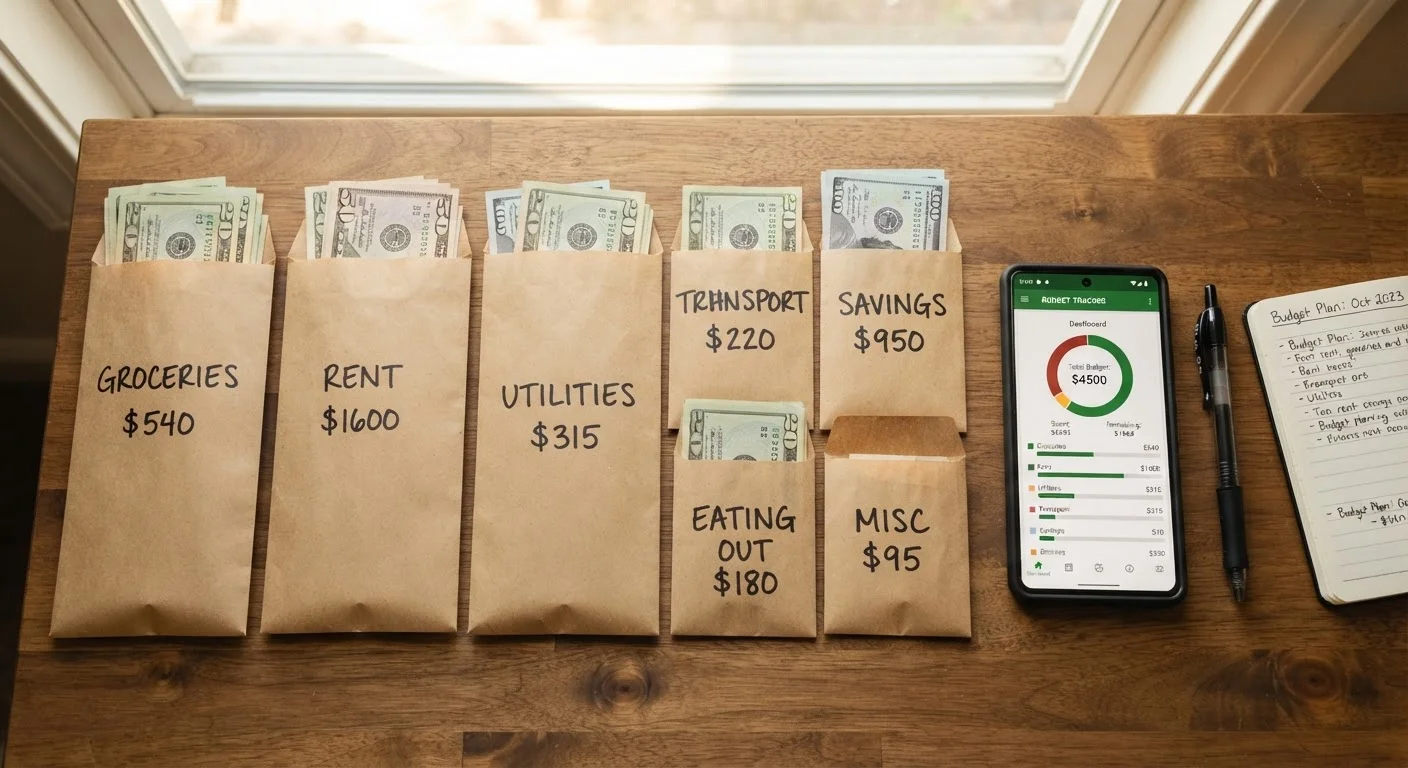
Envelope budgeting - How it works: Cash is divided into labeled envelopes, one per spending category. When an envelope is empty, spending in that category stops for the month. Digital variants use app-based "envelopes" rather than physical cash.
Best suited for: Tactile learners and those who consistently overspend in specific categories like groceries or dining. The physical (or visual) constraint makes limits concrete.
Trade-offs: Managing physical cash is inconvenient for many households; digital versions require discipline to treat virtual envelopes as real limits.
Values-based budgeting - How it works: Spending categories are ranked by personal priority rather than prescribed percentages. Money flows first to what matters most to you - whether that's family experiences, health, or early retirement - and discretionary areas are funded last.
Best suited for: People who feel disconnected from rigid category rules and want their budget to reflect their actual life goals.
Trade-offs: Requires honest self-reflection to define priorities, and offers less external structure, which can make accountability harder. The complete guide to personal budgeting explores how to layer values-based thinking onto other methods.
This article provides general financial education and is not personalized financial advice. Consult a qualified financial professional for guidance specific to your situation.