
The Quiet Components That Keep Everything Moving
Oil changes and tire rotations get most of the attention in routine car care. But a handful of smaller, less-discussed components quietly do just as much heavy lifting - and when they finally give out, the consequences can be severe and sudden. Spark plugs, drive belts, and coolant hoses rarely announce their decline in obvious ways. They degrade gradually, often showing no clear symptoms until they cross a critical threshold.
Understanding what each component does, how long it typically lasts, and what failure looks like puts you in a better position to stay ahead of the problem. As part of any scheduled maintenance plan, these items deserve regular attention - not just a glance when something feels wrong. For a broader view of what routine service covers across a vehicle's life, the complete maintenance overview is worth bookmarking.
Spark Plugs
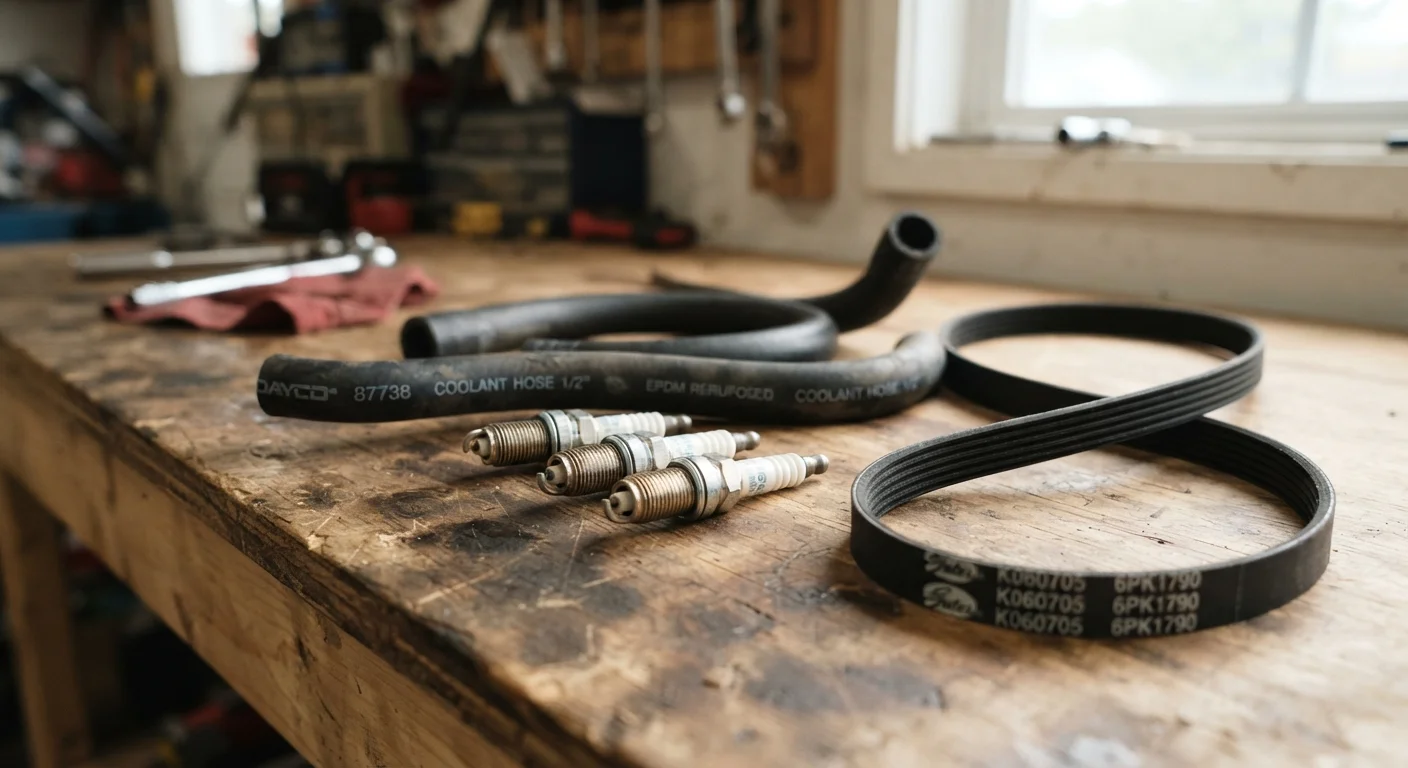
Spark plugs ignite the air-fuel mixture inside each cylinder. A clean, properly gapped plug produces a strong, consistent spark; a worn one misfires, wastes fuel, and stresses the ignition coils. Most conventional copper plugs are rated for around 30,000 miles, while iridium and platinum variants can last 60,000 to 100,000 miles or more depending on the vehicle. Check your owner's manual for the spec that applies to your engine.
Signs of wear: rough idle, hesitation on acceleration, reduced fuel economy, or a check-engine light tied to a misfire code. Because symptoms can be subtle, many drivers don't notice degraded performance - they simply adapt to it over time.
A misfiring spark plug strains ignition coils and silently erodes fuel economy before you notice anything.
Serpentine Belt
The serpentine belt is a single continuous loop that drives the alternator, power steering pump, air conditioning compressor, and water pump on most modern vehicles. It runs constantly whenever the engine is on, and it stretches and hardens over time. Many manufacturers recommend inspection around 60,000 miles and replacement by 100,000 miles, though this varies.
Signs of wear: squealing noise on startup (especially in cold or wet conditions), visible cracking on the belt's ribbed surface, or flickering electrical systems. If a serpentine belt snaps while driving, the engine may overheat within minutes and power steering assist is immediately lost - creating a safety hazard. Have it inspected before reaching that point.
A snapped serpentine belt can overheat your engine within minutes and eliminate power steering instantly.
Timing Belt (Where Applicable)
Not all vehicles have a timing belt - some use a timing chain, which is generally more durable. But in many four-cylinder engines, a rubber timing belt synchronizes the crankshaft and camshaft, controlling valve timing precisely. Replacement intervals typically fall between 60,000 and 105,000 miles. This is one of the most consequential services on the list: in interference engines, a broken timing belt causes piston-to-valve contact, resulting in severe internal engine damage.
Signs of wear: there are often none. Timing belts frequently fail without visible symptoms. This is precisely why the manufacturer's mileage interval - not the appearance of the belt - is the most reliable guide. When replacing the belt, mechanics often recommend replacing the water pump and tensioner at the same time, since labor costs overlap significantly.
Timing belts often fail without warning - the manufacturer's mileage interval is your most reliable guide.
Coolant Hoses
Coolant hoses carry hot antifreeze between the engine, radiator, and heater core. The upper and lower radiator hoses handle the highest pressures and temperatures and are most prone to failure. Rubber hoses degrade from the inside out - the exterior can look intact while the interior liner is cracking and collapsing. Most hoses have a serviceable life of around five to seven years, though this varies with climate, mileage, and coolant condition.
Signs of wear: soft or spongy feel when squeezed (engine cold), visible swelling near clamp ends, minor weeping or residue around connections, or a sweet smell near the hood. A burst hose causes immediate coolant loss and rapid overheating. During any coolant flush or radiator service, ask your mechanic to inspect hose condition while the system is already open.
Coolant hoses degrade from the inside out - the exterior can look fine while failure is already developing.
Vacuum Hoses
Vacuum hoses are smaller, often overlooked lines that connect sensors, emission controls, and braking systems to the intake manifold. They're under constant heat and pressure cycling, which causes them to crack, harden, or collapse over time. A failing vacuum hose creates an unmetered air leak that throws off the engine's air-fuel ratio and sensor readings.
Signs of wear: rough or erratic idle, hissing sound from the engine bay, increased fuel consumption, or trouble-code-driven check-engine lights. Vacuum leaks can be difficult to diagnose without proper equipment, and they're sometimes mistaken for more serious issues. A mechanic can use a smoke machine to locate leaks quickly. This is one area where common maintenance misconceptions - like assuming a rough idle always means a sensor problem - can lead to unnecessary part replacements.
A cracked vacuum hose mimics sensor failures and throws off engine tuning without triggering obvious symptoms.
PCV Valve Hose
The positive crankcase ventilation (PCV) system routes combustion gases back into the intake to be burned rather than vented to the atmosphere. The PCV valve and its connecting hose are small but critical for engine health and emissions compliance. The hose connecting the valve to the intake manifold is prone to the same heat-related deterioration as other rubber lines.
Signs of wear: oil consumption without visible leaks, oil residue around the valve cover or air filter housing, or a rough idle. A collapsed or cracked PCV hose can allow unfiltered air into the intake or cause excessive crankcase pressure, which pushes oil past seals. It's an inexpensive part to replace and often overlooked during routine inspections.
A failing PCV hose can push oil past engine seals and cause unexplained oil consumption over time.
Don't Wait for a Warning Light
The components covered here share a common trait: they don't always trigger a dashboard warning before they fail. Your vehicle's onboard diagnostics are good at detecting misfires and some electrical faults, but a cracked hose or a fraying belt may go undetected until it's too late. This is why mileage-based inspection schedules - not just symptom-based visits - are the more reliable approach.
Use Your Owner's Manual as a Starting Point
Your vehicle's owner's manual lists manufacturer-recommended replacement intervals for belts, plugs, and hoses - often in the maintenance schedule section near the back. These intervals are based on typical driving conditions. If you frequently drive in extreme heat, tow loads, or stop-and-go traffic, ask your mechanic whether earlier inspection makes sense for your situation.
It's also worth knowing that some maintenance beliefs can lead drivers in the wrong direction. The car maintenance myths article addresses a few widespread misconceptions that cost real money over time. And if you're evaluating a used vehicle where maintenance records are unclear, understanding these wear items becomes even more important - see our car buying guidance for context on what to look for before purchase.
This article is for general informational purposes only. Always consult a qualified mechanic for diagnosis, inspection, and repair decisions specific to your vehicle.