
Purchase Price and Incentives
EVs generally carry a higher sticker price than comparable gasoline vehicles, though the gap has narrowed meaningfully in recent years. Federal tax credits - currently up to $7,500 for qualifying new EVs under the Inflation Reduction Act - can reduce out-of-pocket costs, though eligibility depends on income limits, vehicle price caps, and where the vehicle is assembled. Some states layer additional credits on top.
Gasoline cars typically offer more financing options and a wider range of entry-level price points. Buyers comparing total purchase cost should factor in available incentives alongside the sticker price rather than treating them as separate considerations. For a broader look at what purchase price actually represents in context, see the true cost of owning a car.
Fueling vs. Charging: Costs and Convenience
Electricity is generally less expensive per mile than gasoline, though the margin depends on local utility rates and gas prices in your area. Drivers who charge primarily at home overnight - using a Level 2 charger - tend to see the clearest savings. Public fast charging is convenient for road trips but is priced closer to gasoline on a per-mile basis at many networks.
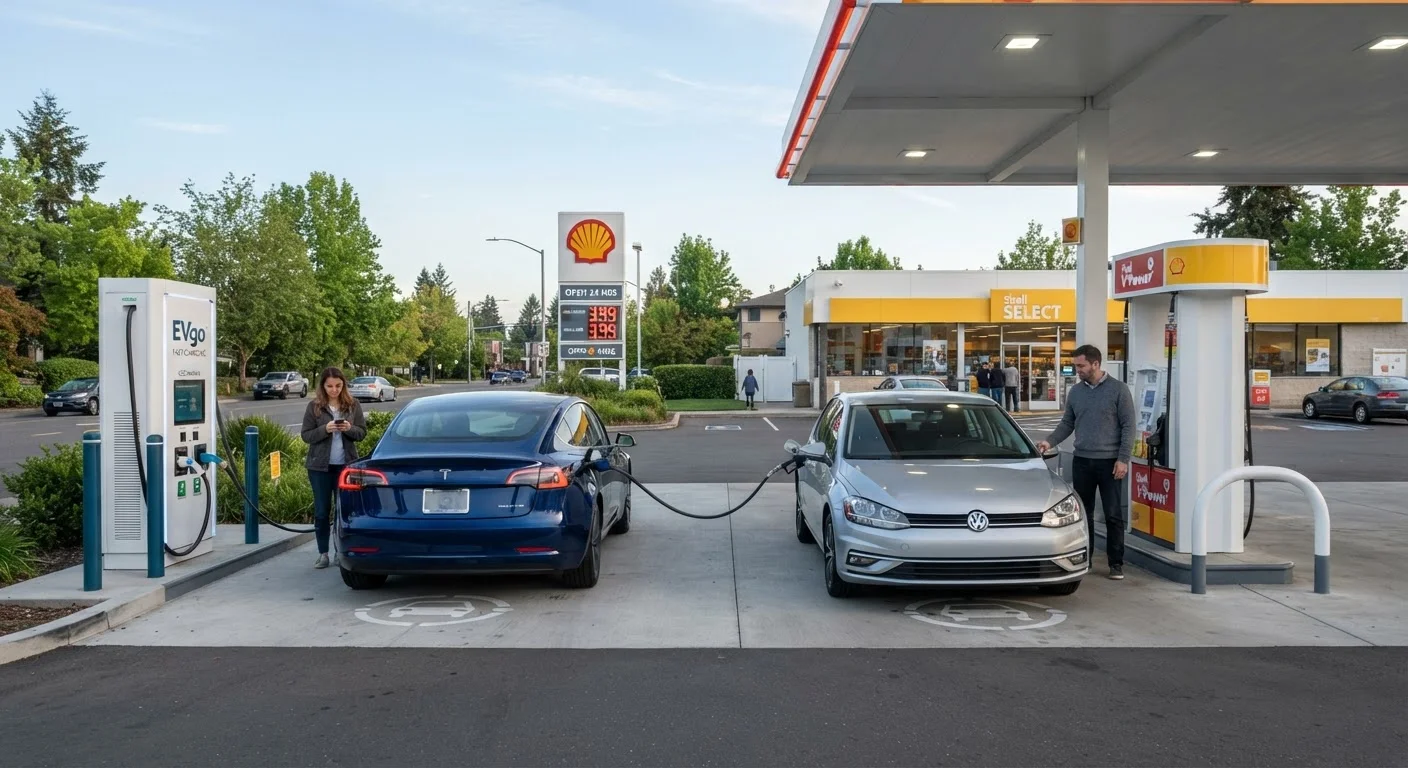
Gasoline refueling takes roughly five minutes almost anywhere in the country. EV charging on a public DC fast charger takes 20-45 minutes for a significant charge, while overnight home charging requires planning ahead. Buyers should honestly assess their daily driving pattern and whether their home or apartment allows charger installation.
| Electric Vehicle | Gasoline Car | |
|---|---|---|
| Typical upfront cost | Higher; incentives may offset | Lower entry-level options available |
| Per-mile energy cost | Generally lower (electricity) | Generally higher (gasoline) |
| Refueling time | 20-45 min (fast charge) | ~5 minutes |
| Routine maintenance | Fewer items; no oil changes | Regular oil, filters, belts |
| Long-distance convenience | Requires charging planning | Stations virtually everywhere |
| Insurance cost (general trend) | Tends to run higher | Typically lower on average |
| Cold-weather performance | Range reduced in cold | Minimal range impact |
Maintenance: What Actually Changes
EVs have fewer moving parts than internal combustion engine (ICE) vehicles, which translates to a different - often reduced - maintenance profile. There are no oil changes, no spark plugs, no timing belts, and no transmission fluid services. Brake wear is reduced because regenerative braking (recapturing energy to slow the car) handles much of the deceleration load.
However, EVs are not maintenance-free. Brake fluid, cabin air filters, tire rotations, and coolant for battery thermal management all require periodic attention. Battery health is the central long-term concern: degradation over time can reduce range, and battery replacement, if ever needed, is expensive. Gasoline vehicles carry their own set of ongoing costs - oil changes, filters, belts, and more - that are well understood. For a grounded look at what maintenance really costs on either platform, it helps to separate fact from habit; common car maintenance myths apply to both types.
Check Charging Access Before You Commit
Home charging is the most practical and cost-effective option for most EV owners. Before purchasing, confirm whether your home or apartment building can accommodate a Level 2 charger installation - this often requires a dedicated 240-volt circuit. Renters should check with landlords early, as installation approval isn't guaranteed. If home charging isn't feasible, factor public charging costs and availability carefully into your decision.
Range, Infrastructure, and Real-World Driving
Most new EVs offer 200-300+ miles of EPA-rated range, though real-world range varies with speed, temperature, climate control use, and cargo load. Cold weather in particular reduces battery efficiency noticeably - a relevant consideration for buyers in northern states.
Public charging infrastructure has expanded significantly but remains uneven. Urban and suburban drivers generally have good access to Level 2 and DC fast chargers; rural drivers may find stations sparse. Gasoline stations remain ubiquitous nationwide, which is a genuine practical advantage for unpredictable itineraries or frequent long-haul travel.
Prospective EV buyers should map their typical routes and verify charging availability before committing. The car-buying process is a useful framework for building this kind of due diligence into the decision.
Insurance Considerations
Auto insurance for EVs tends to cost more on average than for equivalent gasoline vehicles. Higher repair costs - driven by expensive battery components, specialized parts, and fewer trained technicians - contribute to elevated premiums. Collision and comprehensive coverage are particularly affected.
That said, insurance pricing is highly individual. Rates vary based on the specific model, driver history, location, and insurer. Some EV models may carry lower premiums than others. Buyers should request quotes for any specific vehicle they're seriously considering rather than assuming a category-level average applies to their situation. General guidance on navigating coverage decisions is available through auto insurance resources.
This article provides general educational information about vehicle types and is not financial, tax, or professional advice. Incentive eligibility, insurance terms, and financing options vary by individual circumstances - consult qualified professionals for guidance tailored to your situation.