What You're Actually Looking At
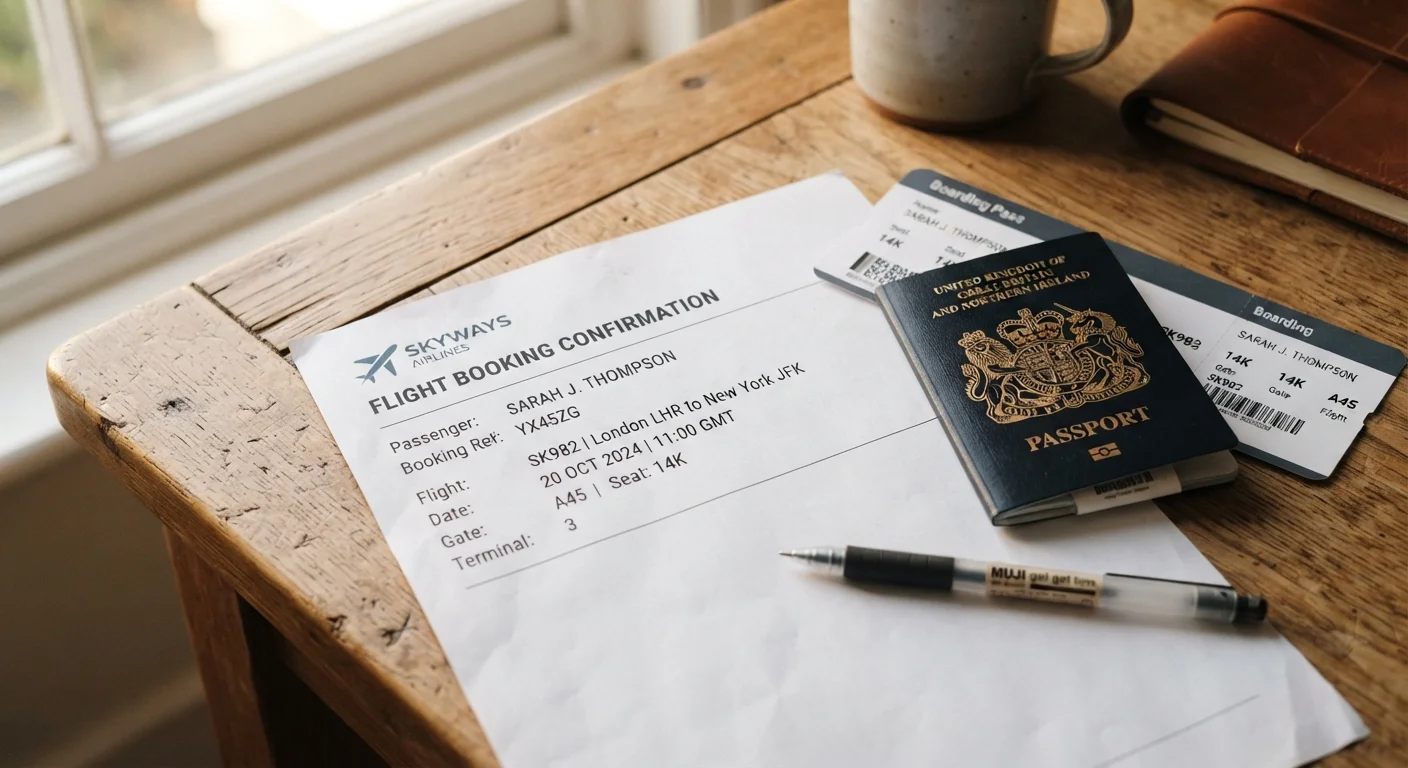
When your booking confirmation arrives by email, it can feel like a wall of codes, abbreviations, and fine print. Every element has a specific meaning - and knowing what each piece represents helps you catch errors, plan connections, and understand your rights before you fly.
This reference breaks down the most common terms and fields found on a standard US flight itinerary. For a broader look at organizing all your travel documents into a coherent plan, see The Anatomy of a Well-Planned Trip Itinerary.
| Airport Code Format | 3-letter IATA code (e.g., JFK, LAX, ORD) (International Air Transport Association) |
| Airline Carrier Code Format | 2-letter IATA code + numeric flight number (e.g., DL 404) (International Air Transport Association) |
| Booking Reference (PNR) Length | 6 alphanumeric characters (Standard across major global distribution systems) |
| Typical Domestic Minimum Connection | 60-90 minutes (varies by airport) (General carrier guidance; confirm with your airline) |
| Typical International Minimum Connection | 2-3 hours (varies by airport and customs requirements) (General carrier guidance; confirm with your airline) |
Airport Codes, Flight Numbers, and Routing
Airport codes are three-letter identifiers assigned by the International Air Transport Association (IATA). For example, LAX is Los Angeles International and ORD is Chicago O'Hare. Always verify the code matches the specific airport you intend to use - some metro areas have multiple airports with different codes.
Flight numbers combine the airline's two-letter IATA carrier code with a numeric identifier (e.g., AA 247 or UA 1138). The number itself has no inherent meaning about speed or quality; it simply identifies the scheduled service.
Routing shows the sequence of airports in your journey. A nonstop flight lists two airports; a connecting itinerary lists three or more, with layover city codes in between. Pay attention to whether a layover requires you to clear customs and re-check baggage - this is commonly the case on international-to-domestic connections.
IATA Code
A three-letter identifier assigned to airports worldwide by the International Air Transport Association. Used to indicate origin, destination, and connection points on your itinerary.
Fare Class
A single letter designating the pricing tier and rules attached to your ticket. It is not the same as cabin class (economy, business) and determines flexibility for changes or cancellations.
Codeshare
An arrangement where one airline sells seats on a flight physically operated by a different carrier. Your ticket may show one airline's number while another airline's staff and aircraft serve the route.
Minimum Connect Time
The shortest layover duration an airport officially deems sufficient to transfer between flights. Booking a connection shorter than this threshold carries a higher risk of a missed flight if any delay occurs.
PNR (Record Locator)
A six-character alphanumeric code - sometimes called a booking reference or confirmation number - used by airlines to retrieve your reservation in their system.
Baggage Allowance
The number, size, and weight of bags you may carry or check without additional fees, as defined by the carrier and fare purchased. Allowances differ by route, cabin, and loyalty status.
Fare Classes, Ticket Rules, and Baggage
Fare class (also called booking class) is a single letter on your itinerary - such as Y, B, or Q - that indicates the pricing tier and associated rules for your seat, not the physical cabin. Two passengers in identical seats may hold different fare classes with entirely different change and cancellation policies.
Ticket rules govern what you can do after purchase. Common restrictions include minimum-stay requirements, advance-purchase deadlines, and change or cancellation fees. Some fares are fully refundable; most discounted fares are not. The ticket rules section of your confirmation or the carrier's website states these terms explicitly - read them before assuming flexibility.
Baggage allowances appear as a combination of carry-on and checked-bag entitlements, often expressed as piece counts and weight or size limits. Allowances vary by carrier, fare class, destination, and loyalty program status. Fees for bags purchased at the gate are typically higher than those added during online check-in, so review your allowance well before travel day.
For context on when to book and how far in advance allowances and policies tend to firm up, see Travel Booking Timelines.
Layovers, Connections, and Codeshares
A layover is any scheduled stop between your origin and destination. The duration matters: US carriers generally recommend a minimum of 60-90 minutes for domestic connections and 2-3 hours for international ones, though official minimum connect times vary by airport. If your first flight is delayed and you miss a connection that was booked on a single itinerary, the operating carrier is typically responsible for rebooking. If you booked two separate tickets, that protection usually does not apply.
A codeshare flight is marketed by one airline but operated by another. Your itinerary may show the marketing carrier's flight number while a different airline actually flies the aircraft. This affects which carrier's baggage policy applies, where you check in, and which loyalty program miles you earn. Check the "operated by" field on your confirmation.
Codeshare Flights and Baggage Policy
When your flight is a codeshare, the baggage policy that applies is typically that of the operating carrier - the airline whose staff and aircraft actually run the flight - not the marketing carrier whose name is on your ticket. Always confirm which carrier is operating your flight and look up that carrier's current baggage rules before packing. Policies can differ significantly between partner airlines.
This article is part of a larger trip-planning framework - see Trip Logistics From Start to Finish for an end-to-end planning guide.