How Each Rate Structure Is Defined
When you borrow money, the lender charges interest - the cost of using their funds. How that interest rate is set and whether it can change over time is what separates a fixed-rate loan from a variable-rate loan.
A fixed-rate loan carries an interest rate that is set at origination and does not change for the life of the loan. Whether you repay over three years or thirty, the rate printed in your agreement is the rate you pay from the first payment to the last.
A variable-rate loan (also called an adjustable-rate loan) ties your interest rate to an external benchmark - commonly a published index such as the prime rate or the Secured Overnight Financing Rate (SOFR). Your rate equals that index plus a lender-set margin. When the index moves, your rate moves with it, typically on a schedule defined in your loan agreement (monthly, quarterly, or annually).
Understanding this distinction is foundational to evaluating any borrowing product. For a broader look at how these concepts show up in your everyday spending, see how fixed and variable expenses differ in your household budget.
| Criterion | Fixed-Rate Loan | Variable-Rate Loan |
|---|---|---|
| Interest rate over time | Stays the same throughout | Moves with a benchmark index |
| Monthly payment stability | Fully predictable | Can rise or fall |
| Starting rate (typical) | Usually higher | Usually lower |
| Benefit if market rates fall | Only via refinancing | Automatic rate reduction |
| Risk if market rates rise | None - rate is locked | Payment increases |
| Best loan term fit | Long-term loans | Short-term or flexible loans |
| Rate cap protection | Not applicable | Often included; verify terms |
How Each Structure Behaves Over the Life of a Loan
The real difference between these two structures becomes visible not at signing, but over time - as economic conditions shift.
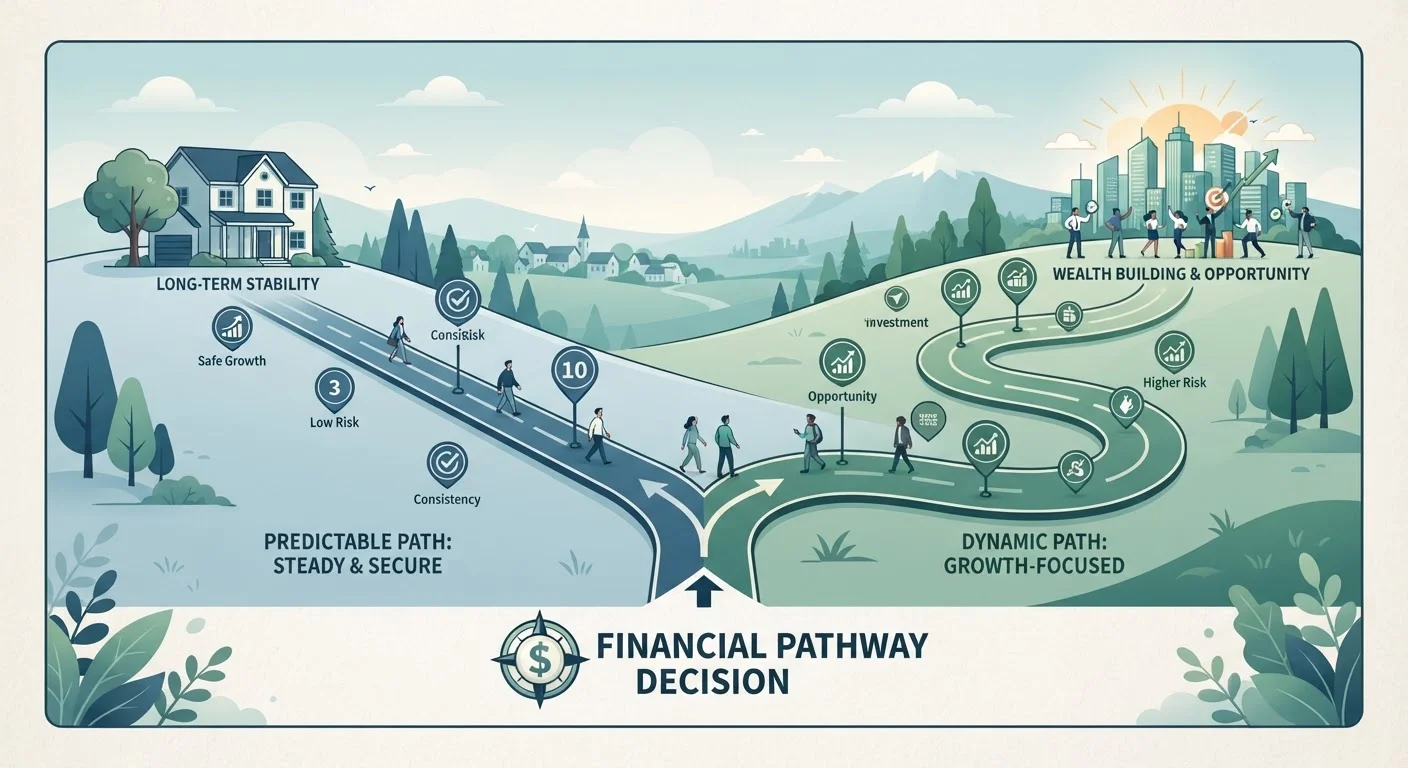
Fixed-rate behavior: Your payment is identical in month one and month sixty. If market rates rise sharply after you close, you are insulated. If rates fall, you do not automatically benefit - though refinancing may be an option, which carries its own costs and qualifications.
Variable-rate behavior: Your payment can change on a regular schedule. In a falling-rate environment, your cost of borrowing decreases without any action on your part. In a rising-rate environment, your payment increases, sometimes substantially. Many variable-rate products include a rate cap - a ceiling on how high the rate can go - which limits but does not eliminate that risk.
Because variable rates are connected to benchmark indexes set by market forces and influenced by central bank policy (the Federal Reserve sets the federal funds rate, which ripples through many consumer lending benchmarks), borrowers with variable loans are effectively exposed to macroeconomic conditions throughout their repayment period.
~93%
Share of new mortgages with fixed rates
According to Federal Reserve data, the vast majority of US mortgage borrowers have historically opted for fixed-rate products, particularly in periods of rate uncertainty.
Prime + margin
Typical variable-rate formula
Many variable consumer loans are priced as the current prime rate plus a fixed margin set by the lender at origination, per standard US lending practice.
For a detailed look at the range of loan products that use these structures, the guide to common loan types covers mortgages, auto loans, HELOCs, and more.
Trade-Offs to Weigh Before Choosing
Neither structure is objectively better - each involves trade-offs that matter differently depending on your circumstances.
Fixed-Rate Trade-Offs
- Stability: Payments never increase, simplifying budgeting.
- Higher starting rate: Lenders price certainty into fixed rates, so the initial rate is often higher than an equivalent variable offer.
- No automatic benefit from falling rates: You would need to refinance to access a lower rate, which involves fees and a new credit inquiry.
Variable-Rate Trade-Offs
- Lower initial rate: The starting rate is typically below a comparable fixed rate, reducing early payments.
- Payment uncertainty: Future payments are difficult to forecast, which can complicate long-term budgeting.
- Rate caps provide partial protection: Most consumer variable-rate products include lifetime and periodic caps, but you should read those terms carefully before signing.
If you are weighing a personal loan specifically, a balanced look at personal loan trade-offs can help you think through the broader costs and risks involved. You might also find it useful to compare personal loans against credit cards as borrowing alternatives.
This article is for general informational and educational purposes only and does not constitute personalized financial or lending advice. Consult a qualified financial professional before making borrowing decisions based on your individual circumstances.