
Why Nutrition Research Is Inherently Complex
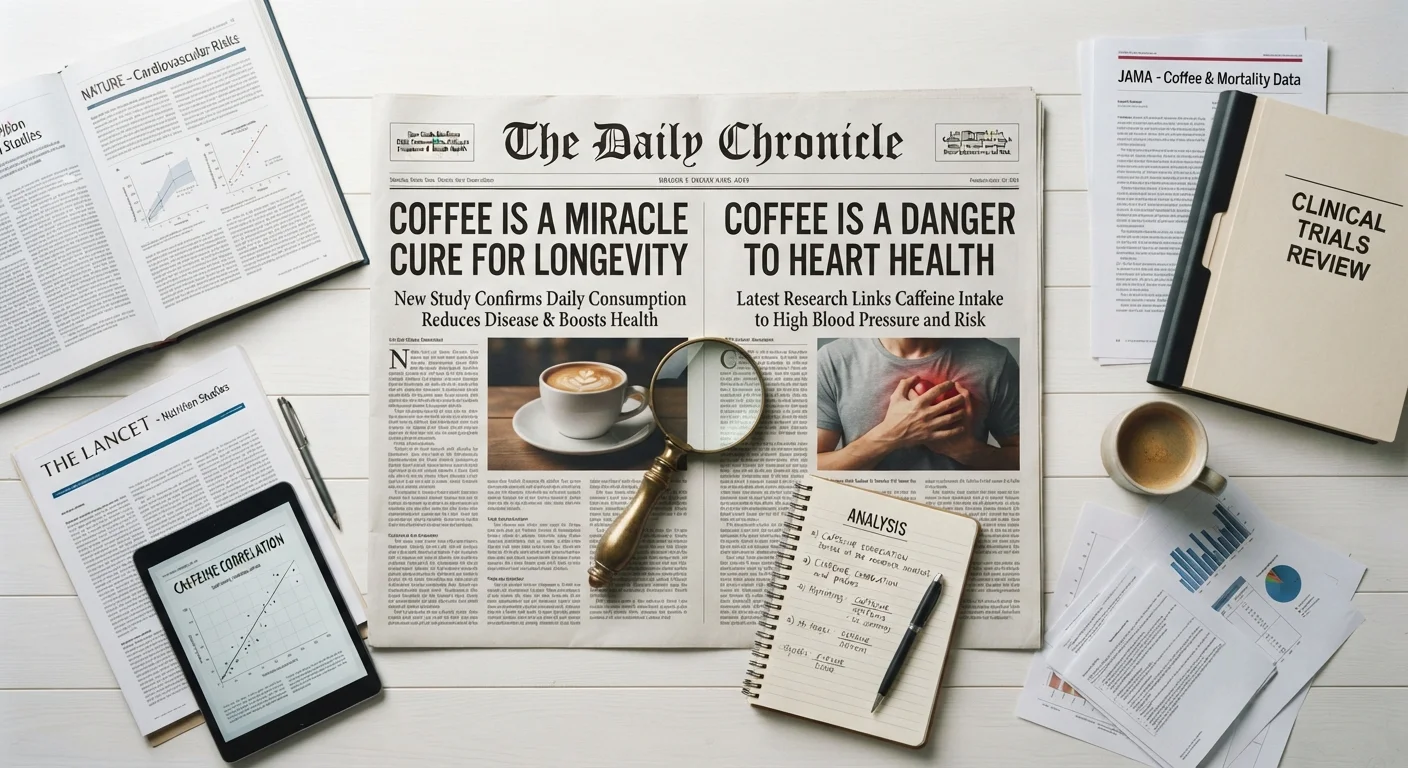
Few fields generate as many contradictory headlines as nutrition. One week, coffee is linked to longer life. The next, it's flagged as a concern. Understanding why this happens starts with recognizing what makes nutrition uniquely difficult to study.
Unlike testing a single drug against a placebo, studying diet means tracking hundreds of variables simultaneously - what people eat, how much, how food is prepared, and how those choices interact with sleep, stress, genetics, and socioeconomic factors. Isolating the effect of one food or nutrient in a real human life is extraordinarily hard.
Researchers also can't ethically control every meal a person eats for decades. That's why much nutritional research depends on surveys and self-reporting, which introduces its own well-documented challenges around memory, underreporting, and social desirability bias. For a plain-language breakdown of the terms researchers use in these studies, see our nutrition concept glossary.
~80%
Share of nutrition studies that are observational
Research in nutritional epidemiology is dominated by observational designs, according to analyses published in peer-reviewed nutrition journals, which limits the ability to claim causation.
74%
US adults confused by conflicting nutrition advice
A survey by the International Food Information Council found nearly three-quarters of US adults reported confusion from contradictory food and nutrition information.
10-30 yrs
Time needed to study diet and chronic disease
Chronic conditions like heart disease and type 2 diabetes develop over decades, making it practically difficult to run sufficiently long controlled dietary trials.
The Study Types Behind the Headlines
Not all nutrition studies carry equal weight, and knowing the difference changes how you read a headline.
- Observational studies track large populations over time and look for patterns. They can identify associations - people who eat more vegetables tend to have lower rates of certain conditions - but they cannot confirm that vegetables directly caused the better outcomes.
- Randomized controlled trials (RCTs) randomly assign participants to different dietary conditions and measure results. These are considered the gold standard for establishing causation, but they're costly, logistically difficult, and rarely run long enough to capture long-term dietary effects on chronic disease.
- Meta-analyses and systematic reviews pool data from multiple studies. When a meta-analysis across dozens of studies consistently points in the same direction, that carries considerably more weight than any single paper.
Headlines almost always feature single studies - usually observational - rather than the broader consensus they represent. That gap between what was studied and what gets reported is a primary driver of public confusion.
“The problem is not that nutrition science is broken - it's that we expect it to behave like physics. Diet operates in a complex biological and social system, and the research reflects that complexity.”
— Dr. David Katz, Preventive medicine specialist and founding director of the Yale-Griffin Prevention Research Center
The Role of Individual Variation
Even when a study is rigorous, its findings apply to an average result across a sample population. Your body may respond differently based on genetics, gut microbiome composition, medication use, activity level, and underlying health conditions.
For example, research shows that people metabolize saturated fats, carbohydrates, and even caffeine at meaningfully different rates depending on genetic variations. A dietary pattern that produces measurable benefits in one population subgroup may show neutral or different results in another.
This is why dietary patterns with a strong research base - rather than single-nutrient rules - tend to hold up better across diverse populations. They're flexible frameworks, not rigid prescriptions. It's also worth understanding that nutritional needs themselves shift across life stages, as explored in our article on nutrition through different life stages.
How to Read a Nutrition Headline Without Being Misled
A few practical questions can help you evaluate any nutrition claim before accepting or dismissing it:
- Is this one study or a body of evidence? A single study - no matter how well-designed - should be viewed as a contribution to a conversation, not the final word.
- Was the study done in humans? Animal and cell studies are important early steps, but they don't directly predict effects in people.
- How large was the sample, and how long did it run? Larger, longer studies are generally more reliable for dietary research than small, short-term ones.
- Who funded the research? Industry-funded studies aren't automatically invalid, but independent replication adds credibility.
- Does it contradict a large existing body of evidence? One outlier result rarely overturns established guidance.
Rather than reacting to every new finding, understanding common nutrition myths and the evidence behind them can help you build a more stable foundation for evaluating claims. Likewise, zooming out beyond single nutrients - as discussed in our article on why calorie counting alone misses the point - often gives a more accurate picture of what research actually supports.
This article is for general informational and educational purposes only and is not a substitute for professional medical or dietary advice. Consult a qualified healthcare provider or registered dietitian nutritionist for guidance tailored to your individual health needs.