
Why Insurance Myths Are an Expensive Problem
Auto insurance is one of the largest recurring costs of vehicle ownership, yet many drivers base their coverage decisions on persistent myths rather than facts. Acting on bad information can mean paying too much for the wrong coverage - or being dangerously underinsured when a claim actually occurs.
The myths below are among the most widely believed in the US. Understanding why each one is wrong is the first step toward making smarter, more cost-effective coverage choices. For a foundational overview, see our plain-language guide to how auto insurance works.
Myth
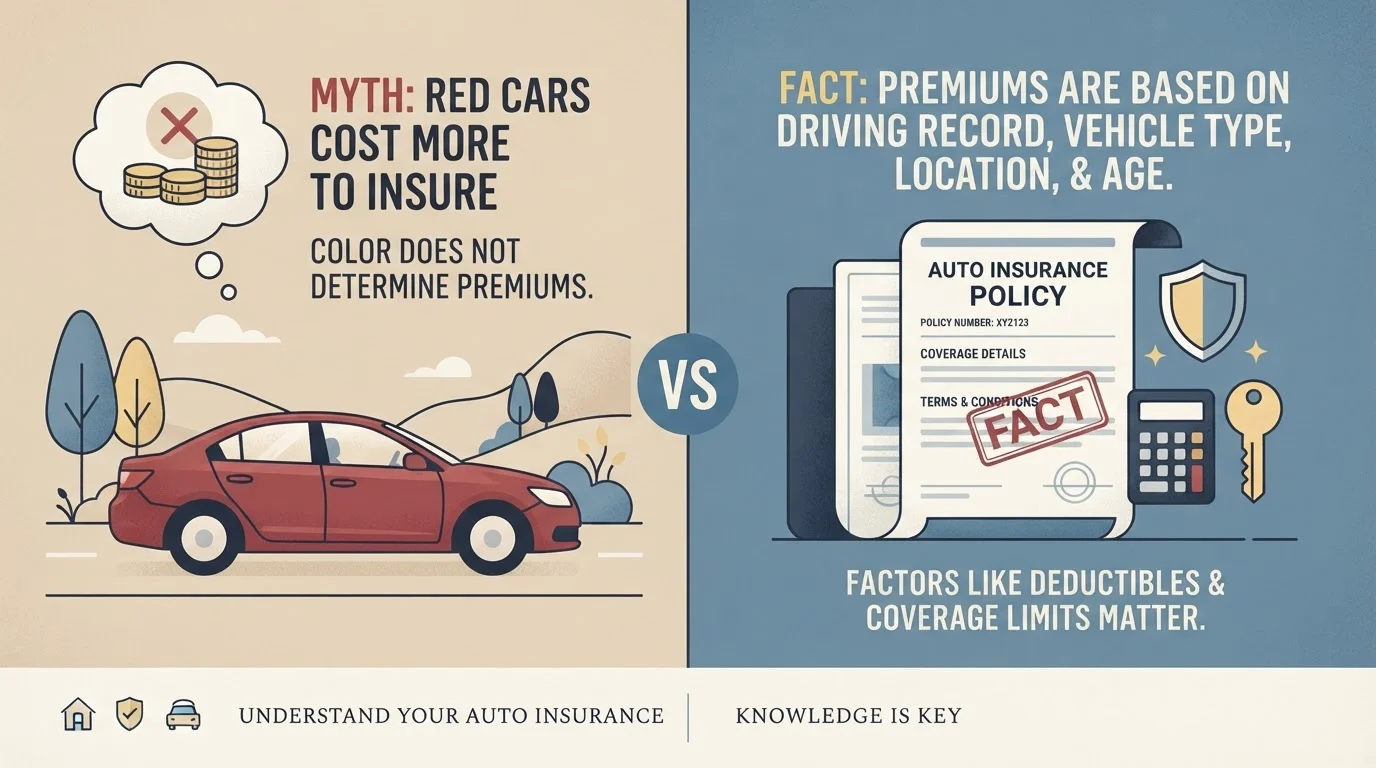
Red cars cost more to insure because insurers charge more for bright colors.
Fact
Insurers do not ask for - or factor in - the color of your vehicle when calculating premiums.
This is one of the oldest auto insurance myths in circulation. Premium calculations are based on the vehicle's make, model, body style, age, engine size, safety ratings, and theft statistics - none of which involve exterior color. The idea that red signals speed or recklessness to an underwriter has no basis in standard rating practices used by US insurers.
Myth
Once a car is paid off or gets older, you can drop all coverage and save money.
Fact
Dropping comprehensive and collision coverage on an older vehicle is a calculated risk, not a guaranteed saving - and it can backfire significantly.
Whether it makes financial sense to remove physical damage coverage depends on the vehicle's current market value, your ability to absorb an out-of-pocket repair or replacement cost, and how the car is used. A vehicle worth $4,000 that you rely on daily may still warrant comprehensive coverage, particularly in areas prone to hail, flooding, or vehicle theft. Liability coverage, meanwhile, is legally required in nearly every state regardless of vehicle age.
Myth
Your credit score has nothing to do with your car insurance rate.
Fact
In most US states, insurers use a credit-based insurance score as one of several factors in setting premiums.
Insurers have historically found a statistical correlation between credit-based insurance scores and the likelihood of filing claims. As a result, most states permit the use of this score in auto insurance underwriting. A few states - including California, Hawaii, and Massachusetts - restrict or prohibit this practice. If you live in a state that allows it, improving your broader credit profile may over time have a modest positive effect on your insurance rate.
Myth
State minimum liability coverage is enough - you're legally covered, so you're fine.
Fact
State minimums set a legal floor, not a financial safety net. They are often far lower than the cost of a serious accident.
Minimum liability limits vary by state but are frequently set at levels like $25,000 per person for bodily injury - a figure that can be exhausted quickly in a multi-vehicle accident involving medical care and lost wages. If a judgment against you exceeds your policy limits, you are personally responsible for the difference. Drivers with significant assets or income typically need higher limits than the state minimum to adequately protect themselves.
Myth
You should always file an insurance claim - that's what you pay premiums for.
Fact
Filing a claim for minor damage can cost you more in premium increases over time than the claim itself was worth.
Insurers track claims history, and even a single at-fault claim can trigger a rate surcharge that persists for several years. For small repairs - a minor fender scrape, a cracked windshield where you have separate glass coverage - it's worth calculating whether the payout offsets the likely premium impact before filing. This doesn't mean avoiding claims for significant losses, but routine small-dollar claims deserve a cost-benefit review first.
Myth
Your personal auto policy covers you if you drive for a rideshare or delivery app.
Fact
Standard personal auto policies typically exclude coverage during rideshare or delivery activity - a gap that can leave drivers financially exposed.
Most personal auto policies contain exclusions for commercial or for-hire use. Rideshare companies generally provide some coverage during active trip periods, but there are gaps - particularly during the period when a driver is logged into the app but hasn't yet accepted a ride. Drivers who use their vehicle for any app-based income should ask their insurer about a rideshare endorsement or look into a commercial policy that addresses the full spectrum of their driving activity.
What These Myths Have in Common - and What to Do Instead
Each of the myths above shares a root cause: drivers apply intuitive but oversimplified logic to a system that insurers have built on actuarial data, state regulation, and detailed risk modeling. The factors that actually move your premium - driving record, location, credit score, and vehicle use - are often invisible at the surface level.
~38%
Drivers who carry only minimum liability
Industry estimates suggest a substantial share of US drivers carry only state-minimum liability limits, leaving significant financial exposure in serious accidents.
3-5 years
How long an at-fault claim can affect your rate
Depending on the insurer and state, an at-fault accident surcharge typically remains on a driver's record and affects premiums for three to five years.
The practical takeaway is straightforward: review your declarations page at every renewal, not just your total premium. Confirm that your liability limits reflect your actual financial exposure, that you haven't dropped coverage you genuinely need, and that any discounts you qualify for are being applied. Our detailed breakdown of which factors shape your auto insurance rate can help you interpret what you're paying and why.
If you're in the market for a vehicle, keep in mind that insurance costs vary significantly by make, model, and trim - a reality explored further in our guide to car-buying myths that cost drivers money. And if misconceptions aren't limited to insurance in your financial life, it's worth reading about credit score myths that can cost you money as well.
This article is for general informational purposes only and does not constitute personalized insurance, legal, or financial advice. Coverage terms, eligibility, and premiums vary by insurer, policy, and state. Consult a licensed insurance agent or adviser for guidance specific to your situation, and always review actual policy documents before making coverage decisions.