
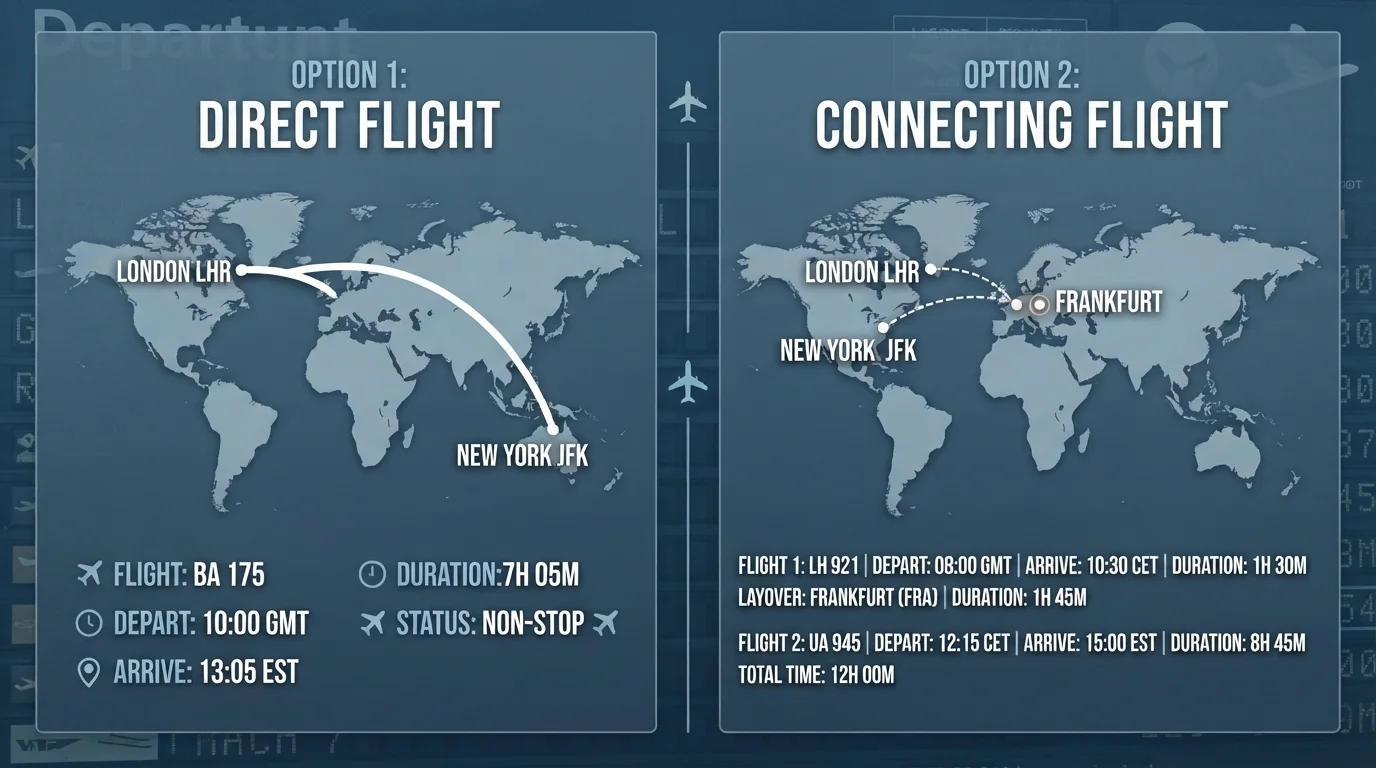
The Core Trade-Off: Time vs. Cost vs. Risk
When you're deciding between a nonstop and a connecting flight, three variables are always in play: total travel time, fare cost, and the probability that something goes wrong. Understanding how these interact - rather than focusing on any one factor - leads to better decisions.
Nonstop flights eliminate intermediate stops entirely. You board once, land once, and your trip's logistics are contained to a single flight. Connecting flights introduce at least one intermediate stop, requiring you to deplane, navigate another airport, re-board, and hope each segment runs on schedule.
For travelers weighing how air travel fits into a broader trip, it's worth reading our comparison of flying versus driving or taking the train - the same trade-off logic applies across modes.
| Criterion | Nonstop Flights | Connecting Flights |
|---|---|---|
| Total travel time | Shortest - direct city-to-city | Longer - adds layover time |
| Typical fare | Often higher on same route | Often lower, varies by route |
| Disruption risk | Lower - single segment | Higher - each stop adds risk |
| Baggage mishandling risk | Lower - no transfer needed | Higher - bags re-routed at each stop |
| Route availability | Limited to major city pairs | Available for nearly all destinations |
| Planning complexity | Simple - one booking, one airport | More variables to manage |
| Rebooking protection | Straightforward within one ticket | Protected if same-carrier ticket; risky if separate tickets |
Disruption Risk: Where Connections Create Vulnerability
Each connection is a potential failure point. A delayed inbound flight, a gate change, or even routine air traffic congestion can collapse a connection and strand you for hours - or overnight. The U.S. Department of Transportation's Bureau of Transportation Statistics consistently shows that on-time performance varies significantly by route, airline, and time of year, which means disruption risk isn't hypothetical.
Layover duration is the primary lever you control at booking. Domestically, a minimum of 90 minutes is a commonly cited guideline; internationally, two hours or more is generally advisable, accounting for customs, immigration, and longer concourse distances. Short layovers - under an hour - save time on paper but leave almost no buffer for real-world delays.
~2%
U.S. checked bag mishandling rate
According to the U.S. Department of Transportation, mishandling rates - including delayed, damaged, or lost bags - are measurably higher on itineraries involving connections than on nonstop flights.
90 min+
Recommended domestic minimum layover
Travel logistics guidance from aviation consumer resources consistently cites 90 minutes as a practical domestic layover floor, with two hours or more advised for international connections.
~20%
U.S. flights arriving late in a typical year
Bureau of Transportation Statistics data shows that roughly one in five U.S. flights does not arrive on time in any given year, underscoring why buffer time at connections matters.
Baggage handling is a related risk. Checked bags must be re-tagged and transferred at each connection point, and industry data shows mishandling rates are higher on itineraries with connections than on nonstop flights. If you're checking bags on a connecting itinerary, build in extra time and consider whether carry-on only is feasible for your trip.
Cost Differences: How Much Do Connections Actually Save?
Connecting flights are often cheaper, but the margin isn't fixed - it depends on the route, the carrier, how far out you're booking, and the season. On high-demand routes between major hubs, the difference may be modest. On thinner routes or during peak travel periods, connecting itineraries can run significantly below nonstop fares.
The honest calculation includes more than the ticket price. If a connection adds four hours to your trip each way, that time has a real cost - in missed work, childcare arrangements, hotel nights near the airport, or simply exhaustion. For budget travelers, travel budgeting frameworks can help structure this kind of total-cost comparison rather than letting sticker price alone drive the call.
Also account for what you might spend during a long layover: airport meals, lounge access, or even a hotel for an overnight connection can erode fare savings quickly.
When You Don't Have a Choice - and How to Plan Around It
For a significant share of US city pairs, nonstop service simply doesn't exist. Travelers departing from smaller regional airports, or heading to less-trafficked international destinations, will find that a connection isn't a preference - it's the route. In those cases, the decision shifts: rather than nonstop vs. connecting, you're choosing which connection city, which layover length, and which airline alliance to route through.
Choosing a hub airport with which you have some familiarity reduces navigational stress. Routing through a single airline's own hub, rather than cobbling together separate tickets, also keeps you under one carrier's rebooking obligations if something goes wrong - an important protection that disappears when you book two separate itineraries.
For travelers building more complex itineraries, the connection city itself may offer trip value. Our guide to organizing multi-city trips covers how to sequence stops so a layover becomes part of the destination plan rather than dead time.
Booking Connections on Separate Tickets
Some travelers book two separate one-way tickets to save money - for example, one ticket to the connection city and a separate ticket onward. This eliminates any airline obligation to rebook you if the first flight is delayed and you miss the second. If you go this route, build in a very long buffer between flights and understand that missed connections become entirely your financial responsibility. This approach carries meaningfully more risk than a single through-itinerary.