How Compound Interest Actually Works
At its core, compound interest means your balance earns interest on itself. Suppose you deposit $1,000 into a savings account with a 5% annual interest rate. After year one, you earn $50 in interest, leaving you with $1,050. In year two, your 5% interest is calculated on $1,050 - not the original $1,000 - adding $52.50. That extra $2.50 may seem small, but the effect compounds dramatically over decades.
The standard formula for compound interest is: A = P(1 + r/n)nt, where A is the ending balance, P is the principal, r is the annual interest rate, n is the number of compounding periods per year, and t is time in years. You do not need to memorize this formula, but understanding its inputs clarifies two important levers: time and rate.
For a plain-language reference on related terms like APR, APY, and principal, see our personal finance glossary.
Daily
How often most credit cards compound interest
Most major U.S. credit card issuers calculate interest using a daily periodic rate applied to the outstanding balance, as disclosed in card agreements and confirmed by the Consumer Financial Protection Bureau (CFPB).
$0 → $10,800+
Growth of $5,000 over 30 years at 5% APY
This illustrative figure reflects the compound interest formula at a 5% annual rate, compounded annually, with no additional contributions - demonstrating how an initial deposit more than doubles over a long horizon.
Compound Interest Working For You: Savings and Investments
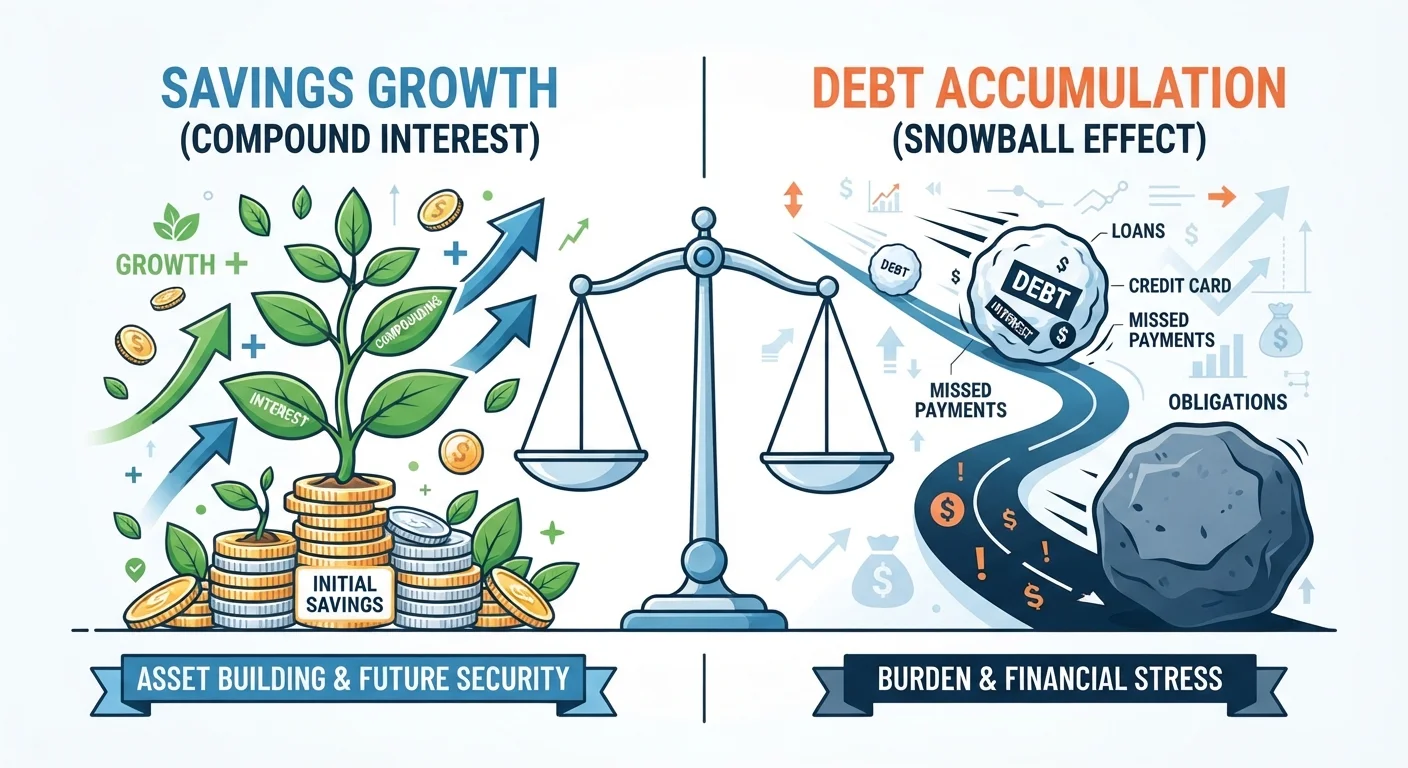
When compound interest works in your favor, time is your most valuable asset. The earlier you begin saving, the more compounding periods your money experiences. A person who begins saving at 25 and stops at 35 - contributing for just ten years - can end up with more at retirement than someone who starts at 35 and saves for thirty years, depending on the rate of return. This counterintuitive result reflects the power of compounding's early periods.
Consistent contributions amplify this effect further. Automatic deposits, even modest ones, allow compounding to work on a growing principal rather than a static one. Automating your savings transfers removes the temptation to skip contributions, helping you maintain the consistency compounding rewards.
“Compound interest is the eighth wonder of the world. He who understands it, earns it; he who doesn't, pays it.”
— Attributed to Albert Einstein, Widely cited in personal finance literature; original attribution is debated by historians
One common mistake is interrupting compounding prematurely - withdrawing savings or pausing contributions during periods of uncertainty. While sometimes unavoidable, gaps in contribution history have a measurable long-term cost that is easy to underestimate.
Compound Interest Working Against You: Debt
The same mathematics that builds savings can accelerate debt. Credit card balances, for example, typically compound daily. The card issuer calculates your daily periodic rate (your APR divided by 365) and applies it to your outstanding balance every single day. If you carry a balance from month to month, you are paying interest on last month's interest - a cycle that can make debt grow faster than expected.
This is why making only minimum payments on a high-rate credit card can keep a borrower in debt for years and cost multiples of the original purchase price. Carrying a credit card balance involves compounding costs that are easy to overlook when you focus only on the minimum payment amount.
Pay More Than the Minimum When Possible
Even small additional payments above the minimum reduce the principal faster, which directly shrinks the base on which interest compounds. On a high-rate credit card, an extra $50 per month can meaningfully reduce both total interest paid and the time to pay off the balance. Use a loan amortization or debt payoff calculator to see the specific impact for your balance and rate.
Student loans and personal loans may also compound interest, though their structures vary. Understanding whether your loan uses simple or compound interest, and how often it compounds, gives you a clearer picture of the true cost of borrowing. This information is available in your loan disclosure documents.
Putting It Together: Balancing Both Sides
Understanding compound interest clarifies a common personal finance tension: should you prioritize saving or paying off debt? Because debt - particularly at high interest rates - compounds against you while savings compound for you, the rate differential matters enormously. If your credit card charges 22% APR and your savings account yields 5% APY, compounding is working against you at a net rate of roughly 17% on every dollar you carry as a balance rather than pay off.
This does not mean saving is pointless while debt exists. An emergency fund, for example, can prevent you from taking on more high-interest debt during an unexpected expense. The right balance depends on interest rates, timelines, and personal circumstances - factors explored in depth in the debt-first vs. savings-first dilemma.
What compound interest makes clear is that passivity is rarely neutral. Leaving high-interest debt unpaid or delaying the start of saving both carry real, compounding costs. Small, consistent actions - paying more than the minimum, contributing regularly to savings - harness the same mathematical force in your favor.
If you find your savings goals stalling despite good intentions, consider reviewing common habits that undermine savings progress. The structural fixes are often simpler than they appear.
This article is for general informational and educational purposes only and does not constitute personalized financial, investment, tax, or legal advice. Consult a qualified financial professional before making decisions about your specific financial situation.