
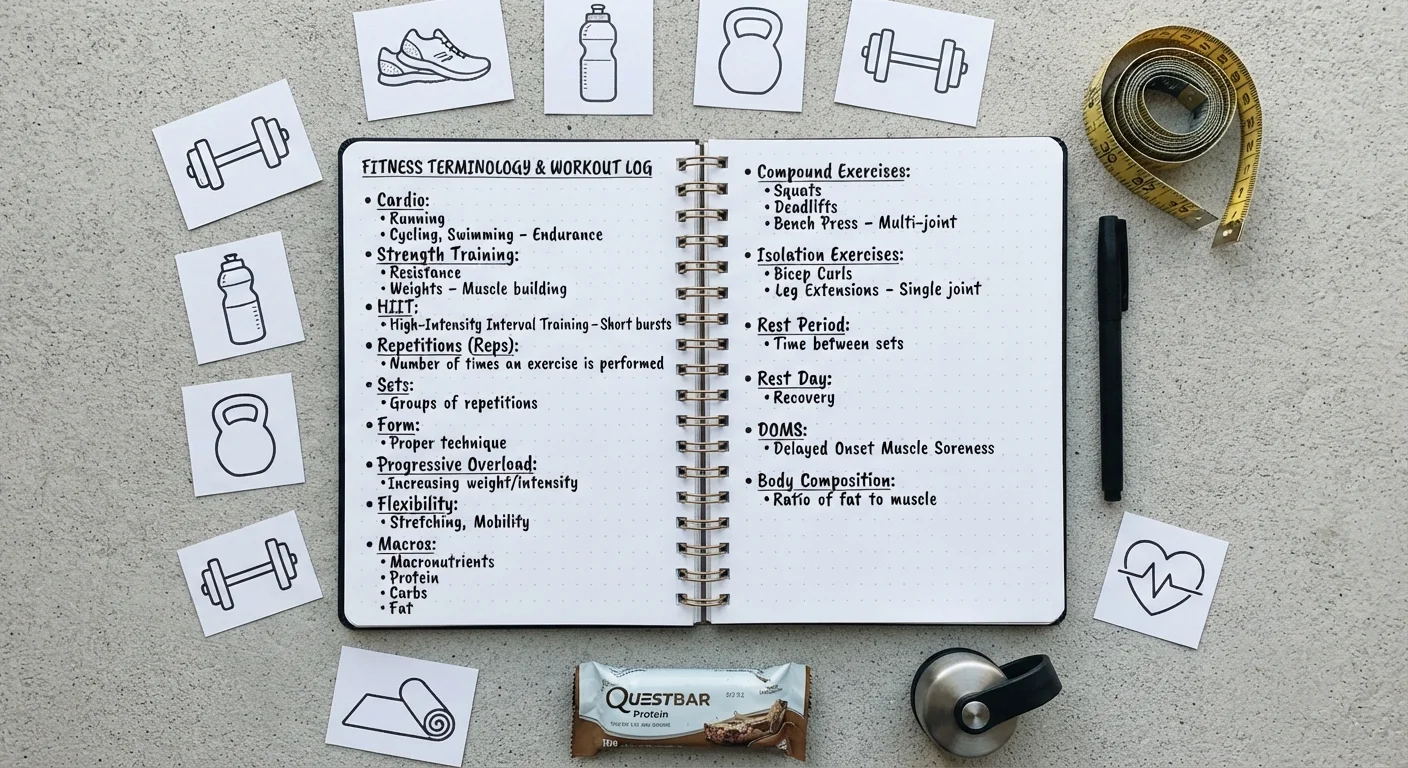
Why Fitness Jargon Matters - and Where It Breaks Down
Fitness content - from magazine workouts to app-guided sessions - leans heavily on shorthand. Terms like RPE, AMRAP, or progressive overload appear without explanation, leaving readers to either guess or disengage. That's a problem, because misunderstanding a key concept can mean misjudging effort levels, structuring workouts poorly, or dismissing an approach that might actually suit you.
This reference is designed as a lookup tool. If you encounter a term in a workout plan or health article and aren't sure what it means, the definitions here give you a grounded starting point. For the nutrition-side vocabulary that often accompanies fitness advice, see our nutrition concept glossary.
This Is General Information, Not Medical Advice
The definitions and descriptions in this article are intended for educational purposes. Individual fitness needs, limitations, and health conditions vary widely. Always consult a qualified healthcare provider or certified fitness professional before starting or significantly changing an exercise program - especially if you have an existing health condition, injury, or have been inactive for an extended period.
Core Terms: Volume, Intensity, and Structure
Most workout plans are built around a handful of structural concepts. Reps and sets describe how an exercise is organized. Training volume - the total work load across a session or week - is one of the primary levers for building strength or endurance over time. The principle of progressive overload connects to volume: to keep making progress, the body needs to encounter increasing challenge, which could mean more weight, more reps, or less rest.
Rest intervals are often overlooked but meaningfully shape outcomes. Shorter rests between sets tend to increase cardiovascular demand; longer rests allow fuller muscular recovery, supporting heavier lifts. Neither is universally better - the right rest period depends on your goal.
| Standard RPE Scale Range | 1 (no effort) to 10 (maximal effort) (Borg CR10 scale, adapted for general fitness use) |
| MET Value at Rest (Sitting) | 1.0 MET (Compendium of Physical Activities) |
| Common HIIT Work-to-Rest Ratio | 1:1 to 1:3 (e.g., 20 sec on, 40 sec off) (Varies widely by protocol and fitness level) |
| Typical Strength Training Rest Period | 60-180 seconds between sets (General resistance training guidelines) |
| Aerobic Activity Heart Rate Zone | Roughly 50-70% of estimated max heart rate (American Heart Association general guidance) |
| Progressive Overload Increment | Often 2.5-5% increase in load per week (Common strength programming convention; varies by individual) |
Eccentric and concentric phases describe what your muscles are doing during a movement. Lowering yourself slowly in a push-up (eccentric) trains the muscle differently than pressing up (concentric). Understanding this distinction helps explain why tempo matters in some programming and why controlled lowering is often emphasized in resistance training guidance.
Effort Measurement: RPE, MET, and Aerobic Zones
Knowing how hard to work is one of the trickier aspects of fitness literacy. RPE (Rate of Perceived Exertion) is a practical self-monitoring tool - it puts a number on how an activity feels, which is useful when heart rate monitors aren't available or when effort needs to be communicated across different fitness levels.
MET (Metabolic Equivalent of Task) is more of a research and public-health tool. It standardizes the energy cost of activities relative to rest, making it possible to compare a brisk walk to a cycling session in a consistent unit. Most consumers won't need to calculate METs directly, but knowing the concept helps when reading public health guidelines that use it. For a deeper look at measurable fitness indicators, fitness metrics worth tracking covers this territory in more detail.
The distinction between aerobic and anaerobic activity is foundational. Aerobic work - sustained, moderate-intensity movement - relies on oxygen and can be maintained for extended periods. Anaerobic work - short, high-intensity bursts - draws on stored muscle energy and cannot be sustained as long. HIIT deliberately alternates between these states, which is why it feels demanding even in short sessions.
Putting the Vocabulary to Work
With these terms in place, workout instructions become considerably easier to interpret. A plan that reads "3 sets of 8 reps at RPE 7, with 90 seconds rest" is now fully readable: three groups of eight repetitions performed at a moderately hard effort, with a minute and a half of recovery between each group.
Functional movement is worth understanding separately, because it often appears in descriptions of exercise philosophy rather than specific exercises. Programs emphasizing functional training prioritize movements that translate to everyday physical tasks - bending, lifting, carrying - rather than targeting single muscles in isolation. Neither approach is inherently superior; both have a role depending on individual goals.
Building a working vocabulary around physical activity also makes it easier to evaluate advice critically - to notice when a claim is based on established exercise science versus trend-driven marketing. For evidence on how to build consistency over time rather than just intensity, movement habits that actually stick explores what behavioral research suggests about sustainable exercise.
This article is for general informational and educational purposes only and is not a substitute for professional medical or fitness advice. Consult a qualified healthcare provider or certified exercise professional before beginning or modifying an exercise program.