
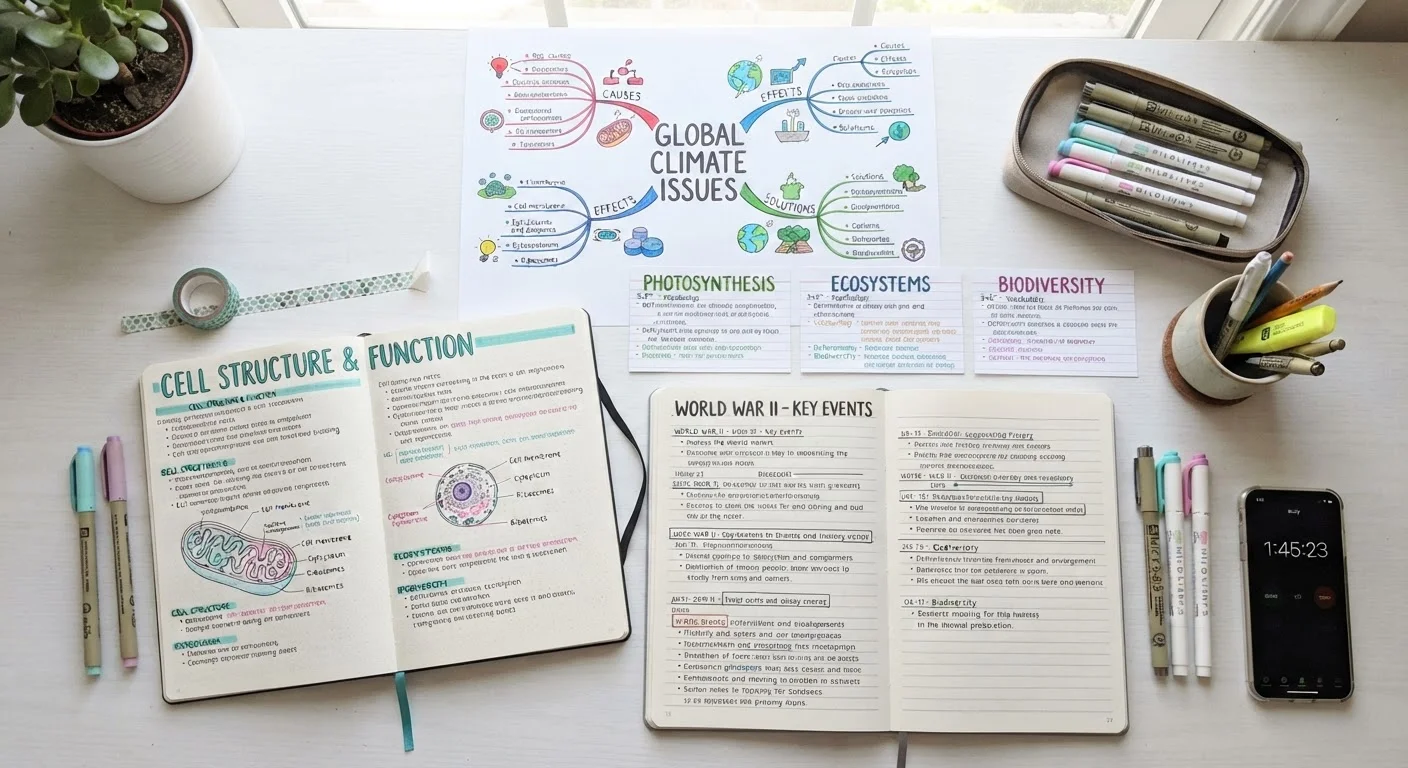
Why Your Note-Taking System Matters
Most people treat note-taking as passive transcription - writing things down so they aren't forgotten. But cognitive science tells a more interesting story. The act of organizing information as you record it is itself a form of processing, and different structures prompt different kinds of thinking. Choosing a system that fits your learning context and cognitive style can improve both comprehension and retention.
This comparison examines four widely used frameworks - Cornell Notes, Outlining, Mind Mapping, and Zettelkasten - across the dimensions that matter most to everyday learners: structure, flexibility, review-friendliness, and suitability for different goals. For complementary strategies, see research-backed study habits that pair well with any of these methods.
| Cornell Notes | Outlining | Mind Mapping | Zettelkasten | |
|---|---|---|---|---|
| Best use context | Lectures, textbooks | Structured, hierarchical content | Brainstorming, synthesis | Long-term knowledge building |
| Learning style fit | Sequential, test-focused | Logical, categorical | Visual, associative | Analytical, research-oriented |
| Speed of capture | Moderate | Fast | Slow during sessions | Slow, requires reflection |
| Review-friendliness | High - built-in cues | Moderate | High - visual overview | High - linked ideas |
| Setup complexity | Low | Very low | Low to moderate | High |
| Scales over time | Moderate | Moderate | Limited | Excellent |
Cornell Notes: Structure Built for Review
Developed at Cornell University in the 1950s, this system divides a page into three zones: a narrow left column for cue questions, a wider right column for notes taken during learning, and a summary section at the bottom. The design is intentionally review-ready - after a session, you cover the notes column and use your cue questions to self-test.
Cornell Notes align naturally with principles like retrieval practice, which research consistently identifies as one of the most effective ways to consolidate memory. The format works especially well for classroom lectures, textbook chapters, and any context where material arrives sequentially. It's less suited to exploratory or creative thinking, where rigid columns can feel constraining. If you're also experimenting with flashcard-based review, Cornell's cue column effectively functions as a hand-written flashcard system.
Outlining: The Logic of Hierarchy
Outlining is probably the most familiar structure - main topics sit at the top level, subtopics indent beneath them, and details nest further still. It's fast to produce, easy to scan, and maps well onto material that already has a clear hierarchy (textbooks, reports, structured lectures).
The limitation is that outlines can impose a false sense of linear order on material that's actually interconnected. A point that belongs under two headings simply can't appear in two places at once. For learners who think in sequences and categories, though, outlining remains one of the lowest-friction systems available. It requires no special tools and integrates easily with most digital note apps. To reduce cognitive load while outlining dense material, the technique of chunking information into meaningful units can make the structure feel more manageable.
Try Combining Outlining with Review
After creating an outline from a lecture or reading, revisit it within 24 hours and add a short summary in your own words at the top. This review step - sometimes called elaborative interrogation - strengthens memory encoding without requiring a complete system overhaul. Even a few sentences significantly increases the value of an outline you'd otherwise never open again.
Mind Mapping: Thinking in Networks
Mind Maps start with a central concept and radiate outward into branches, sub-branches, and connections. The format is non-linear by design, mirroring the associative way memory actually works. A well-built mind map reveals relationships that a list or outline would bury.
Research on visual learning suggests that spatial representations can help some learners encode and recall complex material, though individual results vary significantly. Mind Mapping is particularly useful during brainstorming, exam review, or when trying to understand a new field's landscape before diving into specifics. The trade-off is speed - creating a quality map during a fast-moving lecture is difficult, making this method better for post-session synthesis than real-time capture.
Zettelkasten: Notes That Compound Over Time
Zettelkasten (German for "slip box") was popularized by German sociologist Niklas Luhmann, who reportedly maintained a system of over 90,000 index cards linked by references. Each note - called an atomic note - contains a single idea and includes explicit links to related notes. The system grows more valuable over time as connections accumulate.
Unlike the other three methods, Zettelkasten is not primarily a session-capture tool. It's a long-term knowledge management practice. Many modern practitioners implement it digitally using tools designed for bidirectional linking. The upfront learning curve is steeper, and it requires disciplined maintenance. But for researchers, writers, or anyone building expertise across multiple domains, it's among the most powerful frameworks available. For a broader look at tools that support deep study, see productivity tools for adult learners.
Choosing the Right System for Your Situation
The most effective note-taking system is the one you'll actually use consistently. A few practical questions can help narrow your choice:
- Are you capturing information in real time? Cornell Notes and Outlining are faster under time pressure.
- Do you learn better through visual relationships? Mind Mapping may suit you better than linear formats.
- Are you building a knowledge base over months or years? Zettelkasten is worth the investment in that case.
- Do you regularly need to review and self-test? Cornell's built-in cue column makes that easier.
Many learners find that combining methods works well - outlining during a lecture, then converting key ideas into a mind map or atomic Zettelkasten notes afterward. There's no rule requiring you to pick just one. What matters is that your system serves your learning goals rather than creating extra friction.
If you're exploring other ways to process and retain what you've learned, journaling approaches for mental clarity can complement any of these note-taking frameworks by supporting reflection and consolidation.