What the Research Says About Flashcards in General
Before comparing formats, it helps to understand why flashcards work at all. The core mechanism is active recall - the practice of retrieving information from memory rather than passively re-reading it. Research in cognitive science consistently shows that retrieval practice produces stronger long-term retention than review-only methods. For a deeper look at that evidence, see Active Recall vs. Passive Review: What the Research Actually Says.
Flashcards - in any format - are effective primarily because they force that retrieval attempt. The format debate, then, is really about how well each medium supports retrieval, initial encoding, and sustained practice over time.
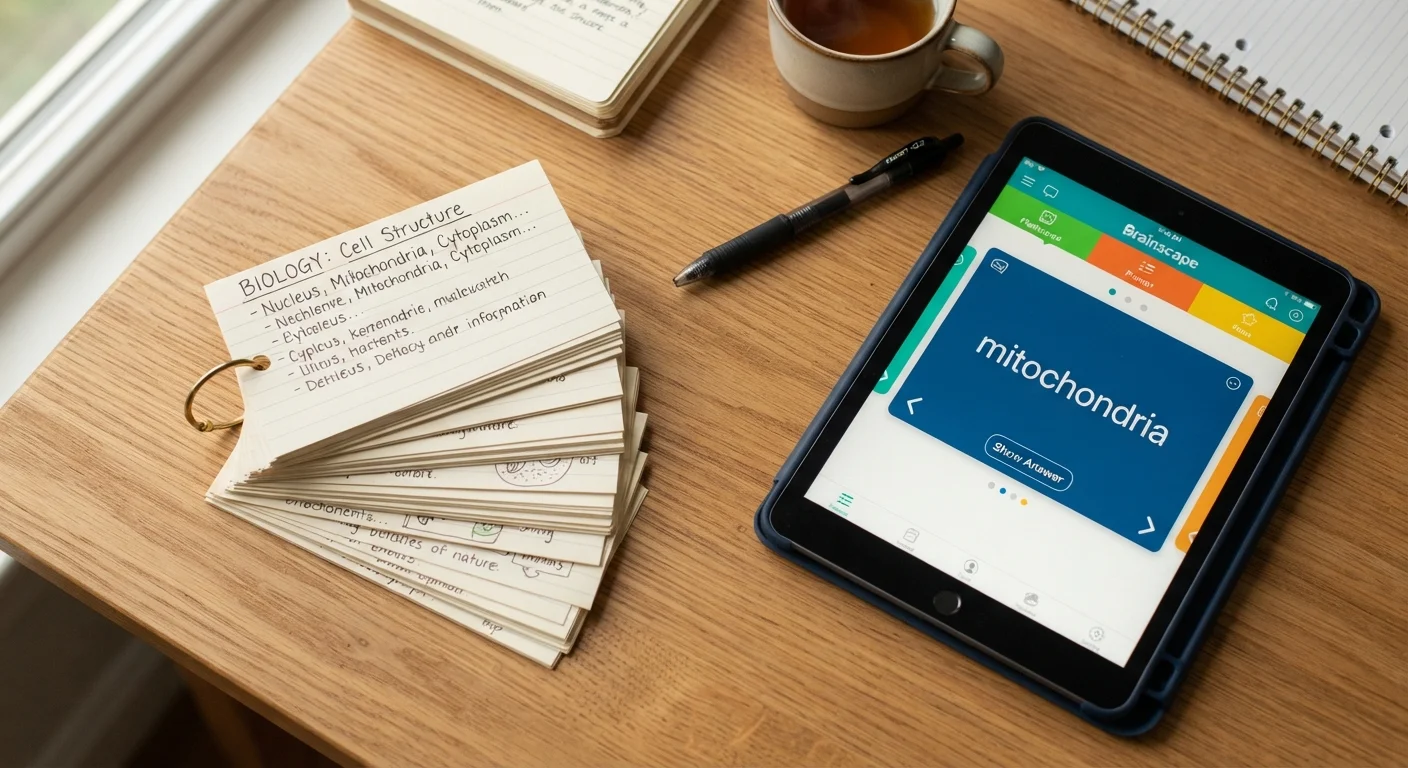
| Criterion | Digital Flashcard Apps | Paper Flashcards |
|---|---|---|
| Spaced repetition | Automated by algorithm | Manual - requires discipline |
| Initial encoding (creation) | Typing; faster but shallower | Handwriting; slower, deeper processing |
| Multimedia support | Audio, images, formatting | Limited to what you can draw or write |
| Portability at scale | Thousands of cards on one device | Physically bulky for large decks |
| Distraction risk | High - shares device with apps | Low - no competing notifications |
| Cost | Free to paid subscription tiers | Low one-time cost for index cards |
| Customization | Tags, decks, media, analytics | Fully flexible but manually organized |
Where Digital Apps Have a Real Edge
The strongest argument for digital flashcard apps is spaced repetition. Apps that implement spaced repetition algorithms (SRS) automatically reschedule each card based on how well you recalled it - surfacing difficult cards more frequently and easier ones less often. This mirrors the spacing effect, one of the most replicated findings in memory research. Managing that scheduling manually with paper is theoretically possible but practically difficult at scale.
Digital apps also offer meaningful advantages for multimedia content. Language learners, for example, can attach native-speaker audio clips to vocabulary cards - something paper cannot replicate. Large decks (hundreds or thousands of cards) are also far more portable and searchable on a device than in a physical box.
~10-30%
Retention improvement from spaced repetition
Meta-analyses in cognitive psychology literature consistently find spaced practice produces meaningfully better long-term retention than massed (cramming) study sessions.
2x
Recall advantage for tested vs. restudied material
The testing effect, documented across multiple laboratory and classroom studies, shows retrieval practice roughly doubles retention compared to rereading the same material.
~65%
Students who report digital distraction during study
Surveys of college students, including research published in educational psychology journals, consistently find a majority report off-task device use during intended study time.
The primary risk with digital tools is the device itself. Studying on the same phone where social media and messaging live introduces friction that can erode study sessions. Learners who struggle with digital distraction may find their net study quality is lower even if the app's algorithm is theoretically superior.
Where Paper Flashcards Hold Their Own
Paper flashcards have a cognitive advantage at the creation stage. Research on handwriting versus typing - most associated with studies examining note-taking - suggests that writing by hand encourages more active processing of information than typing, because it requires paraphrasing rather than verbatim transcription. When you write a flashcard prompt by hand, you are already beginning to encode the concept.
Paper also provides a distraction-free environment by default. There are no push notifications, no temptation to switch apps, and no battery to manage. For learners who find digital environments cognitively taxing or distracting, this alone can make paper the more effective practical choice - regardless of what the algorithm offers in theory.
Physical cards also support certain kinds of spatial and kinesthetic learning. Sorting cards into piles, physically handling the ones you got wrong, or spreading them out to see relationships between concepts can reinforce learning in ways that tapping through a screen does not replicate.
For broader context on how to structure your study environment and tools, the Effective Study Habits Backed by Cognitive Science guide covers research-grounded practices that complement whichever flashcard format you choose.
Making the Decision: Practical Considerations
The format question is rarely all-or-nothing. Many effective learners use digital apps for large, ongoing decks (such as medical school vocabulary or language acquisition) while reserving paper cards for smaller concept sets where the act of writing matters more than automated scheduling.
When deciding, consider these factors:
- Deck size: Above roughly 50-100 cards, manual scheduling on paper becomes difficult; digital apps scale more easily.
- Content type: Audio, images, or dynamic content favors digital. Diagrams you draw yourself may favor paper.
- Your distraction profile: Honest self-assessment here matters more than the theoretical advantages of either tool.
- Study phase: Paper may serve better during initial learning; digital may serve better for long-term retention review.
Flashcards also don't operate in isolation. Pairing them with a coherent note-taking system strengthens both. See Note-Taking Systems Compared for a practical look at how different organizational frameworks support different learning styles. And if you're building out a fuller study toolkit, Productivity Tools Every Adult Learner Should Know About covers complementary tools that reduce cognitive load during study sessions.