
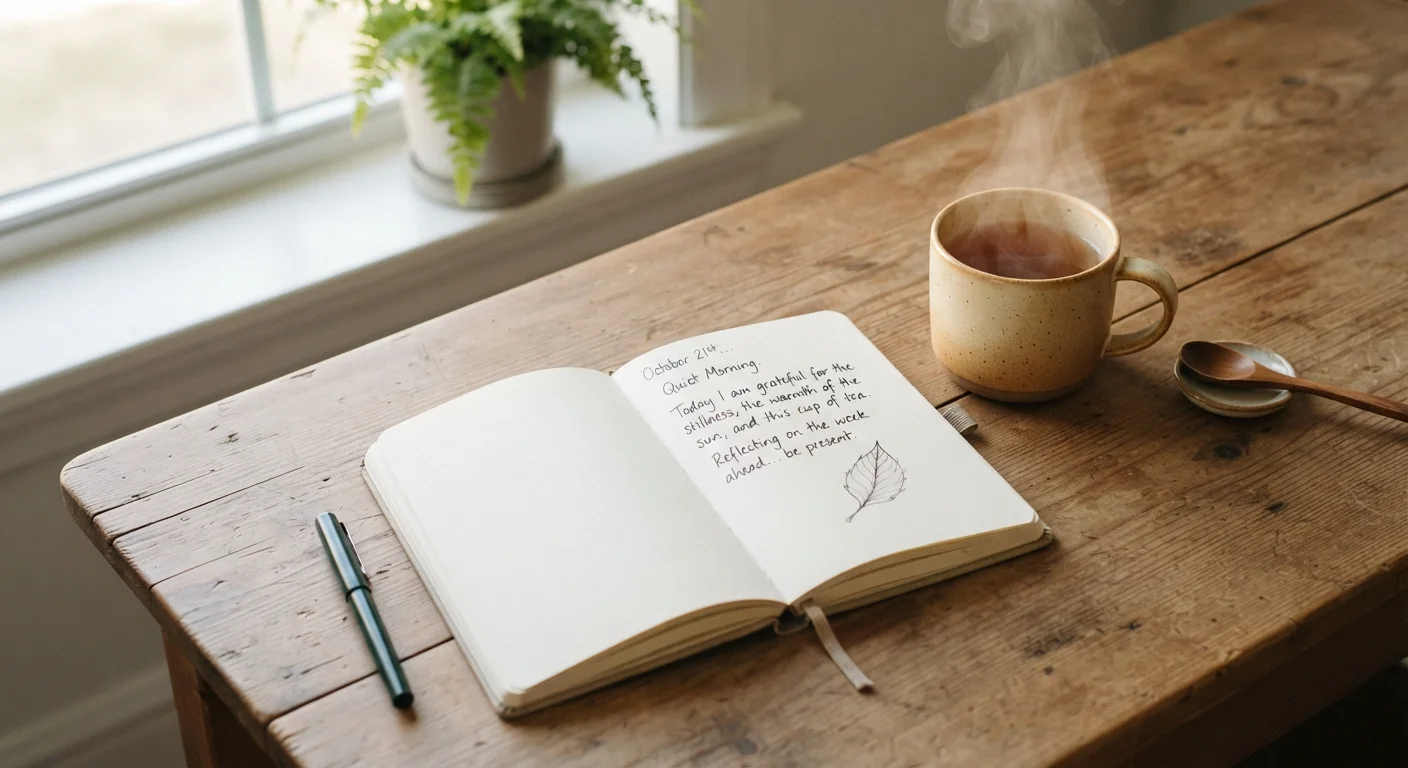
Why Journaling Supports Mental Clarity
Writing about your inner life isn't just a coping habit - it's a practice with a measurable evidence base. Research in psychology has long examined expressive writing as a tool for emotional regulation, with studies exploring its potential effects on stress, mood, and cognitive processing. While journaling is not a clinical intervention, and it is not a replacement for therapy or professional mental health support, it can serve as a meaningful daily tool for many adults.
The underlying mechanism is often described as cognitive offloading - the process of externalizing thoughts so the mind is no longer holding them in active memory. Writing forces you to slow down, find language for diffuse feelings, and observe your own thought patterns from a slight distance. That small shift can make a significant difference in perceived clarity. If you're new to thinking intentionally about your emotional health, this practical mental wellness introduction provides useful foundational context before exploring specific practices.
Four Journaling Approaches Compared
Not all journaling serves the same purpose. Understanding what each style is actually designed to do helps you choose - or combine - approaches that fit your current needs.
| Free Writing | Structured Prompts | Gratitude Journaling | Reflective Journaling | |
|---|---|---|---|---|
| Best suited for | Cluttered or racing thoughts | Beginners or those who feel stuck | Building a positive daily habit | Deeper self-awareness over time |
| Time commitment | 5-15 minutes | 10-20 minutes | 3-5 minutes | 15-30 minutes, periodic |
| Structure level | None - fully open | Moderate - guided by prompts | Low - brief and focused | High - intentional review |
| Primary benefit | Mental release and clarity | Purposeful reflection | Positive reframing | Pattern recognition and insight |
| Ease for beginners | Moderate - requires comfort with openness | High - reduces blank-page friction | High - low effort, quick habit | Low - benefits from prior self-reflection practice |
| Potential limitation | May amplify rumination | Can feel formulaic over time | Can become mechanical | Requires sustained commitment |
Each approach has a different entry point and a different payoff. The overview above offers a starting framework; the sections below go deeper into when each style is most useful.
Free Writing: Thinking Out Loud on the Page
Free writing involves setting a timer - often five to fifteen minutes - and writing continuously without stopping to edit, correct, or judge. The goal is volume and flow, not polish. You write whatever surfaces, even if it's repetitive or incoherent.
This approach is particularly useful for people who feel mentally congested - carrying many concerns, tasks, or emotions simultaneously without being able to sort them. The act of getting it all onto the page, unfiltered, can reduce the sense of internal crowding. It's also an effective way to identify what you're actually thinking when you're not sure, because the constraint of continuous writing often bypasses the internal editor that normally screens thoughts before they're fully formed.
Getting Started With Free Writing
Set a timer for five minutes and write without lifting your pen - or pausing your typing. If you run out of things to say, write "I don't know what to write" until something else arrives. The goal is uninterrupted flow, not insight. Insight often comes later, when you read back what you've written.
The main limitation of free writing is that it generates raw material, not conclusions. Some people find it cathartic; others feel it amplifies rumination. If you notice free writing leaves you more distressed rather than relieved, a more structured format may serve you better.
Structured Prompts: A Framework for Reflection
Prompt-based journaling provides a specific question or sentence starter to respond to - for example: "What's been taking up mental space this week?" or "Describe a moment today when you felt at ease." The prompt acts as a container, giving the writing a direction before it begins.
This style works especially well for beginners, or for anyone who regularly sits down to journal and then stares at a blank page. It also suits those who want their journaling to feel purposeful rather than meandering. Prompts can be thematic - focusing on relationships, values, or goals - or situational, responding to a specific event or emotional state.
One practical note: prompts work best when they're open-ended enough to invite genuine reflection, rather than yes/no answers. "How did that situation make you feel, and what might be underneath that feeling?" tends to produce more insight than "Did you handle it well?"
Gratitude Journaling and Reflective Writing
Gratitude journaling involves regularly noting things - large or small - that you appreciate or that went well. It's one of the most studied self-directed wellness practices, with psychological research exploring its association with positive affect and life satisfaction. It's also one of the lowest-friction formats: three to five items, written briefly, can take under five minutes.
The key is specificity. "I'm grateful for my health" tends to become rote quickly. "I'm grateful that my neighbor waved to me this morning - it was a small thing that shifted my mood" is more likely to generate genuine reflection. Vague entries can turn gratitude journaling into a mechanical exercise that doesn't feel meaningful over time.
Reflective journaling is less about daily check-ins and more about periodic, longer-form self-examination. You might review a week, process a significant event, or write about recurring patterns you've noticed in your own reactions. This style is particularly well-suited to people who want self-awareness as a longer-term goal, not just immediate relief. It pairs naturally with building a structured daily wellness routine, since it encourages you to observe how habits and choices are actually landing over time.
It's worth noting that journaling of any kind can sometimes surface difficult emotions. If writing consistently brings up distressing material - particularly related to trauma, grief, or persistent low mood - consulting a mental health professional is an important step. This article is for general informational purposes and is not a substitute for professional mental health care.
This article is for informational purposes only and is not medical advice. Always consult a qualified healthcare professional for concerns about your mental health.