
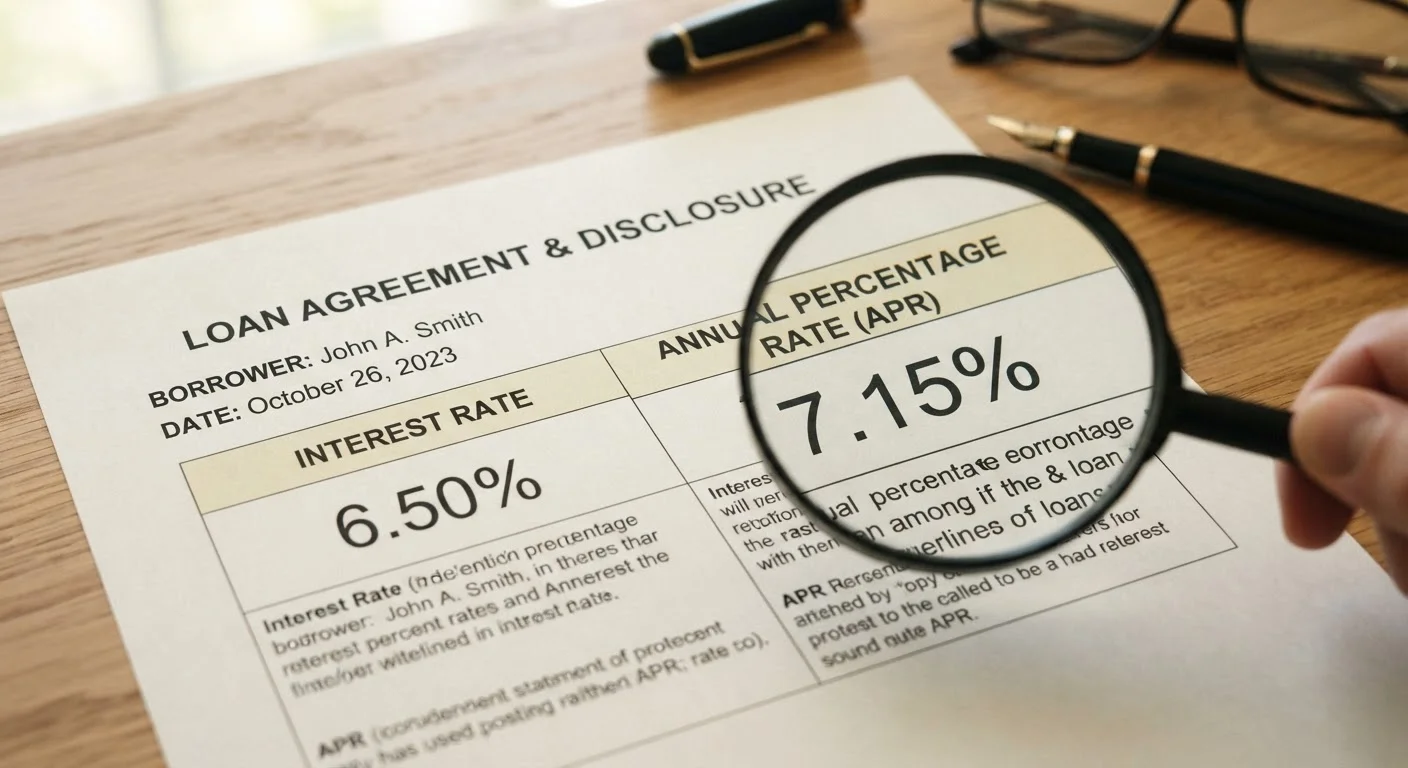
The Interest Rate Is Only Part of the Price
When a lender quotes you a rate on a personal loan, car loan, or mortgage, that number - the interest rate - tells you how much you'll be charged annually on the amount you borrow. It's real, but it's incomplete.
Consider a $20,000 auto loan at a 6% interest rate. That 6% applies only to the principal. What it doesn't capture are the origination fees, broker fees, or other charges that the lender folds into the financing arrangement. Those costs are real money coming out of your pocket, and they're exactly what APR is designed to surface.
The Annual Percentage Rate takes the interest rate and layers in most of the required fees, then expresses the combined cost as a single annual percentage. The result: a number that reflects the full economic cost of the loan - not just one component of it. For a deeper look at how this plays out on a specific loan type, see our auto loan basics guide.
0.5%-2%+
Typical gap between interest rate and APR on mortgages
According to the Consumer Financial Protection Bureau, the difference between a mortgage's interest rate and its APR commonly ranges from under one-half to over two percentage points depending on fees charged.
Millions
Consumers protected annually by TILA APR disclosure rules
The Truth in Lending Act has required standardized APR disclosure in consumer credit transactions since 1968, covering mortgages, auto loans, personal loans, and credit cards.
Why APR Exists - and What the Law Requires
The federal Truth in Lending Act (TILA) mandates that lenders disclose APR prominently on loan offers. The intent is consumer protection: by standardizing how borrowing costs are presented, the law makes it possible for you to compare a loan from one lender against a loan from another without needing to do complicated fee math yourself.
Before TILA, lenders could describe the same loan in different ways - some quoting monthly rates, others emphasizing the interest rate while burying fees in the fine print. APR disclosure was specifically designed to end that confusion.
For mortgage loans, the APR calculation is particularly comprehensive. It typically includes interest, mortgage insurance premiums, origination fees, discount points, and certain closing costs. For personal loans and auto loans, the fees included may be fewer but still significant.
APR vs. APY: Not the Same Thing
APR (Annual Percentage Rate) measures the cost of borrowing. APY (Annual Percentage Yield) measures the return on savings or investment accounts, and it accounts for compounding interest. When evaluating a savings account or CD, APY is the relevant figure. When evaluating a loan or credit card, APR is what you need. Mixing up the two can lead to faulty comparisons.
How to Use APR to Compare Loan Offers
When you receive two loan offers with different interest rates and different fee structures, APR is your apples-to-apples comparison tool. Here's the general approach:
- Collect the APR from each offer - not just the interest rate. Lenders are required to provide it.
- Check what fees are included - a lender might exclude certain fees from the APR calculation, so read the loan disclosure carefully.
- Consider the loan term - APR is an annualized figure. A loan with higher fees spread over 30 years looks different from those same fees on a 3-year loan. Shorter loan terms amplify the effect of upfront fees on the APR.
- Account for variable vs. fixed APR - if the APR can change, ask under what conditions and by how much.
Your credit history plays a direct role in the APR you're offered. Lenders use your credit score to assess risk and set rates accordingly. See our guide to how credit scores are calculated for more on that connection. A full glossary of related terms is available in our personal finance key terms reference.
Common Situations Where APR Makes a Decisive Difference
Understanding when APR matters most helps you focus your attention where it counts.
The pattern is consistent: the longer you hold a loan and the larger the amount, the more the gap between a low-stated interest rate and a higher APR affects your total cost. For shorter-term products or situations where you plan to pay off quickly, other factors - like prepayment penalties - may deserve equal attention.
This article is for general informational and educational purposes only. It does not constitute personalized financial, legal, or investment advice. Consult a qualified financial professional for guidance specific to your situation.