
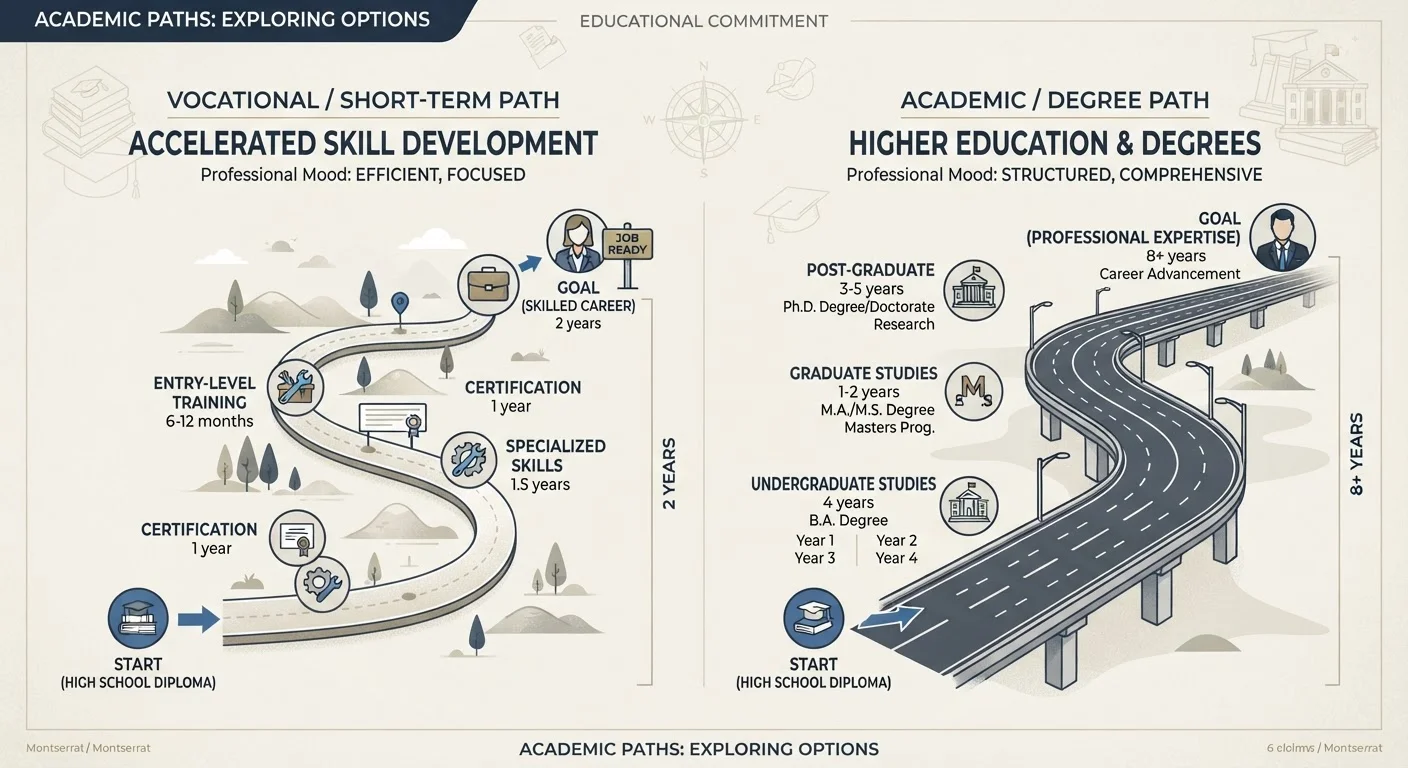
Understanding the Two Credentials
Before comparing outcomes, it helps to understand what each credential actually is. A graduate certificate is a post-baccalaureate program, typically comprising 12-18 credit hours, focused on a defined subject area - think data analytics, instructional design, or healthcare administration. A master's degree is a broader graduate credential, usually requiring 30-60 credit hours, that combines specialization with academic depth, culminating in a thesis, capstone, or comprehensive examination.
For a fuller breakdown of how these credentials differ from diplomas and other designations, see what each credential actually means. Both are offered by regionally accredited institutions, but their weight in the job market and academia differs considerably depending on field and employer.
| Graduate Certificate | Master's Degree | |
|---|---|---|
| Typical duration | 6-18 months | 1.5-3 years |
| Credit hours | 12-18 credits | 30-60 credits |
| General cost range | Lower (fewer credits) | Higher (more credits) |
| Employer recognition | Varies by field and employer | Broadly recognized across sectors |
| Required for licensure | Rarely | Often in regulated professions |
| Depth of study | Focused, specialized | Broad and deep within discipline |
| Pathway to doctoral study | Generally not sufficient | Standard prerequisite |
Time, Cost, and Flexibility
For many adult learners, time and money are the deciding factors. Graduate certificates can frequently be completed in one to three semesters, often in a part-time format designed for working professionals. Master's degrees, even in accelerated formats, typically span at least four semesters full-time - or two to four years part-time.
Cost tracks closely with credit hours. A graduate certificate program carrying 15 credits at a public university might cost $6,000-$15,000 in total tuition, while a 36-credit master's program at the same institution could range from $15,000 to $45,000 or more, depending on residency and program type. These are general ranges - actual costs vary widely by institution and program.
Check Whether Credits Stack Toward a Degree
Some universities allow graduate certificate credits to count toward a master's degree if you decide to continue. This 'stackable' structure lets you start smaller and scale your commitment. Confirm the policy explicitly with the institution before enrolling, as it varies significantly from program to program.
Flexibility considerations are worth examining alongside format. Both credential types are available online at many institutions. The trade-offs between online and on-campus study apply equally to certificates and master's programs and are worth reviewing before you enroll.
Employer Recognition and Career Impact
Master's degrees enjoy broad, well-established recognition across virtually every professional sector. In fields such as nursing practice, social work, school counseling, and university teaching, a master's is not optional - it is a licensing or employment requirement. In research environments, it often serves as a prerequisite for doctoral study.
Graduate certificates occupy a more nuanced position. In fields like cybersecurity, project management, UX design, and supply chain, employers frequently value demonstrated, current competencies - and a certificate from an accredited institution can signal exactly that. However, recognition is far from uniform. Some hiring managers view graduate certificates as meaningful supplements to an existing degree; others may be unfamiliar with the credential entirely. Understanding how your target field weighs credentials is essential. The article fields where certifications outweigh degrees provides useful sector-by-sector context.
Strategic Considerations for Adult Learners
Adult learners returning to formal education face a distinctive set of trade-offs. A graduate certificate can serve as an efficient entry point: it lets you acquire in-demand skills, build a graduate-level academic record, and test your appetite for longer study - often with the option to stack credits toward a full master's degree later, depending on the institution's policies.
Conversely, committing to a master's degree makes most sense when your career goal is clearly tied to a credential requirement, when you want the breadth that only a full program provides, or when you are investing in a long-term trajectory rather than an immediate role change. It is also worth examining whether your goals might be served through skills-based pathways; the comparison between skills-based learning and credential-focused programs can help clarify which approach fits your situation. Finally, verify that any program - certificate or master's - comes from a regionally accredited institution. Accreditation affects credit transferability, employer perception, and eligibility for federal financial aid. For more on credential legitimacy online, see decoding online credentials.